
The Via Francigena
The Via Francigena, often called the Camino to Rome, is one of Europe’s oldest and most remarkable pilgrimage routes. Beginning in Canterbury, England, this ancient trail crosses France, Switzerland, and Italy, ending at St Peter’s Basilica in Rome — the heart of Christendom.
Like the Camino de Santiago, the Via Francigena has been walked by pilgrims for centuries. In medieval times, it linked abbeys and monasteries across Europe, guiding travellers towards the Eternal City. Today, it remains a journey of both faith and discovery, inviting modern pilgrims to slow down and experience Europe’s cultural and natural beauty step by step.
The Via Francigena at a glance: the full route runs for about 2,000 km from Canterbury to Rome, with roughly 1,000 km in Italy from the Great St Bernard Pass. It follows the journey recorded by Sigeric, Archbishop of Canterbury, around the year 990. Walking all of it takes about three months, so most people choose a section – Tuscany, or the last 100 km from Viterbo into Rome.

The route unfolds through some of Europe’s most stunning landscapes — from the White Cliffs of Dover and northern France’s historic plains, to the Alpine passes of Switzerland and the rolling hills of Tuscany. Each region offers its own charm: vineyards, ancient villages, Renaissance art, and Italian hospitality at every turn.
In Italy, the Via Francigena winds through Lucca, Siena, Viterbo, ending with a triumphant arrival in Rome. The Tuscany section is especially popular for its postcard-perfect countryside, while the final 100km to Rome offers a shorter, soulful walk that rewards pilgrims with the Testimonium certificate, similar to the Compostela in Santiago.
Whether you choose to walk or cycle the Via Francigena, this is a journey through history — a path of reflection, beauty, and deep connection with Europe’s spiritual heritage.

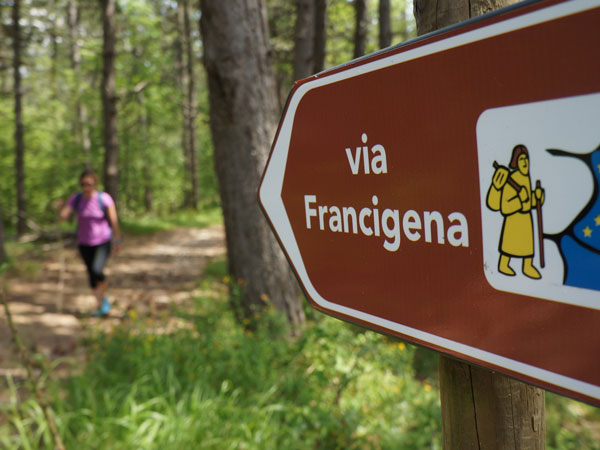


Why Walk the Via Francigena?
Walking the Via Francigena is more than a trek — it’s a journey through Europe’s living history. From the vineyards of Tuscany to the cobbled streets of Siena and the grandeur of Rome, every step feels like walking through time.
It is also a deeply spiritual route: arriving in Rome, the heart of the Catholic world, carries a profound sense of completion. Whether you seek faith, culture, or the sheer beauty of Italy’s countryside, the Via Francigena offers an experience as rich and transformative as the Camino de Santiago.
People come to this route for many reasons, and few of them are purely religious. Some walk for the history – placing their feet on the same path as Sigeric, medieval merchants and countless pilgrims before them. Others come for the landscape, and above all for Tuscany, with its extraordinary mix of art, architecture and food within walking distance. Autumn is especially rewarding: the truffle season, the olive harvest and the grape harvest all coincide with the best walking weather. Walking as a vegetarian or vegan? Tuscany’s seasonal produce makes it easy – see our guide to eating vegetarian on the Via Francigena.
The route is increasingly popular with cyclists, too: the gentle gradients of the Italian sections and the beauty of the Tuscan and Lazio countryside make it a wonderful bike journey. Not sure which section suits you? Read our guide to the best starting points on the Via Francigena.
Suggested Routes


Highlights Of The Via Francigena in Italy
The Via Francigena in Italy passes through some of the best landscapes in Europe. Here are some of the must-see places along this beautiful route:
- Marvel at the historic city of Lucca.
- Step back to San Gimignano, a medieval town whose enchanting streets & historic towers evoke romance & charm.
- Get lost in Siena’s street maze.
- Cycle or walk in the pure Val D’orcia.
- Discover Renaissance Viterbo.
- Visit the Etruscan and Roman sites of Sutri.
- Take in the grandeur of ancient Rome.
- Finish your pilgrimage at St Peter’s Basilica in Vatican City.
This beautiful pilgrimage to Rome was designated a European Cultural Route by the Council of Europe in 1994. Discover more about the Via Francigena on our Camino blog.
Route Options and Stages
- Full Italian route (Lucca–Rome) – about 419 km, up to 20 nights.
- Tuscany (Lucca–Siena) – about 133 km, 7 nights.
- Easy Tuscany (San Miniato–Siena) – about 86 km, 6 nights.
- The last 100 km (Viterbo–Rome) – about 112 km, 6 nights; qualifies for the Testimonium.
- Cycling Lucca–Rome – about 419 km, up to 11 nights.
- Guided tour in Tuscany (San Miniato–Siena) – about 85 km, 6 nights, walking with a guide.
Not sure how much time you need? See how long the Via Francigena takes and our guide to the Via Francigena stages.
Testimonium Certificate on the Via Francigena
The Testimonium is the pilgrim certificate of the Via Francigena, much like the Compostela on the Camino de Santiago. To earn it, you need to walk at least the last 100 km into Rome, or cycle at least the last 200 km.
Carry a pilgrim credential (the credenziale) and collect stamps as you go – in hotels, cafés, churches and tourist offices. When you arrive, show your stamped credential at the pilgrim welcome point at St Peter’s Basilica to receive your Testimonium. Our Viterbo to Rome trip covers the last 100 km. Read more: how to get the Testimonium.
Plan Your Via Francigena
Every walker is different. Some want a gentle week among Tuscan vineyards; others dream of walking the final stretch into Rome. Tell us how many days you have, how far you like to walk each day and the kind of hotels you enjoy, and we’ll shape a Via Francigena trip around you – with your hotels booked, your luggage moved and help on hand 24/7.
Terrain and Difficulty
- A mix of dirt tracks, white gravel roads (the Tuscan strade bianche) and quiet country lanes, with some short stretches on busier roads.
- Rolling hills rather than mountains: expect around 400 m of ascent and descent on a typical day in Tuscany.
- Most of our trips have walking days of roughly 15 to 25 km.
- There is little shade in places, so summer heat can make a stage feel harder than the distance suggests.
- Much easier than alpine treks such as the GR20 or the Tour du Mont Blanc – a good level of everyday fitness is enough.
👉 To prepare, try our Camino fitness plan – it works just as well for the road to Rome.
When to Walk the Via Francigena
- April to June – green hills, wild flowers and mild temperatures.
- September and October – warm days, the grape harvest in Tuscany and fewer crowds.
- July and August – hot, often above 30°C in Tuscany and Lazio, so start early and carry plenty of water.
- Winter – cooler and wetter, and some hotels in small villages close.
👉 Read more in our guide to the best time to walk the Via Francigena.
A few more tips: the Viterbo to Rome section can be walked comfortably for most of the year. If you plan to arrive in Rome around Easter, book early, as it is one of the busiest times in the city. Mountain stretches such as the Great St Bernard Pass are best left to the summer months because of snow, and some rural hotels and guesthouses close between November and March. In summer, you could time your walk for the Palio di Siena, the famous horse race held on 2 July and 16 August.
Via Francigena vs Camino de Santiago
Both are ancient European pilgrimage routes, but they feel very different. The Via Francigena is far quieter: in the 2025 Jubilee year, more than 19,000 pilgrim credentials were issued and over 12,000 pilgrims received the Testimonium in Rome, compared with roughly 500,000 people who received the Compostela in Santiago in 2024. That means more solitude and a slower, more personal journey, but fewer pilgrim hostels – so booked hotels and luggage transfers make a real difference.
The Italian sections are well waymarked, and walking self-guided is very common. For a full side-by-side comparison, read our guide: Via Francigena vs Camino de Santiago.
What To Bring On The Via Francigena in Italy
Most of what you would pack for the Camino works on the Via Francigena too: comfortable, broken-in walking shoes, light layers, a sun hat and a refillable water bottle. Bring something to cover your shoulders and knees for visiting churches and St Peter’s Basilica. Our free packing guide ebook will help you decide what to bring.
History of the Via Francigena
The Via Francigena was first recorded in the 10th century by Sigeric the Serious, Archbishop of Canterbury, who documented his pilgrimage to Rome. His notes mapped the route that later became Europe’s main north–south pilgrim road.
Unlike Roman highways, the Via Francigena was not a single paved road but a network of tracks linking abbeys and trading routes. Over the centuries, it connected pilgrims, merchants, and kingdoms, shaping cultural exchange across Europe.
Revived in the 20th century, the Via Francigena is today recognised as a European Cultural Route (1994) and a living link between past and present.
Sigeric made his pilgrimage in 990 AD to receive his pallium from Pope John XV. On his way home he recorded every stopping place – 80 stages in all – in a travel diary that still survives. It is the oldest known itinerary of the route, and pilgrims who walk “the Via Francigena according to Sigeric” still follow it almost step for step. The name itself means “the road that comes from the land of the Franks”, which is what Italians called the path arriving from northern Europe. Read more in our history of the Via Francigena.
Services That Make It Easy
With CaminoWays, your journey is supported every step:
- Handpicked accommodation in towns and villages.
- Luggage transfers so you travel light.
- Walking notes, maps, and 24/7 assistance.
👉 See Guided Tours.
👉 Or browse Self-Guided Tours.
Prefer to walk with an expert local guide? We also run guided tours in Tuscany on selected dates. For personal advice on the best section and time for you, contact our travel specialists.
FAQs
What is the Via Francigena?
The Via Francigena is a historic pilgrimage route stretching from Canterbury in England to Rome, crossing France, Switzerland, and Italy.
How long does it take to walk the Via Francigena?
Walking the full route can take around three months. Many pilgrims choose shorter sections, such as the scenic Via Francigena in Tuscany or the last 100km into Rome.
What is the Testimonium certificate?
The Testimonium is the official pilgrim certificate, awarded to those who walk at least the last 100km of the Via Francigena into Rome. It is similar to the Compostela on the Camino de Santiago.
What are the highlights of the Via Francigena in Italy?
Highlights include Lucca, Siena, San Gimignano, Viterbo, the rolling hills of Tuscany, and arriving in Rome to visit St. Peter’s Basilica. For comparison, you can also explore the highlights of the Camino Frances.
When is the best time to walk the Via Francigena?
Spring and autumn are the best times, with pleasant weather and fewer crowds. Summer can be very hot, while winter is wet, and many hotels are closed. For preparation tips, check our Camino packing list.
What is the Via Francigena and how is it different from the Camino de Santiago?
The Via Francigena is Europe's other great medieval pilgrimage route, leading to Rome instead of Santiago de Compostela. It stretches from Canterbury in England through France, Switzerland, and Italy, ending at St Peter's Basilica in the Vatican. While the Camino de Santiago is the more famous and busier route, the Via Francigena offers a quieter, more contemplative experience through some of Europe's most iconic landscapes — including Tuscany, the Alps, and the heart of Renaissance Italy. Both routes are recognized European Cultural Routes.
Which is the most popular section of the Via Francigena?
The Tuscany section from Lucca to Siena is the most popular, walked over 7 nights covering 133 km through vineyards, medieval hill towns, and rolling countryside. It includes iconic stops like San Gimignano with its famous towers and Monteriggioni's medieval walls. For pilgrims wanting the official certificate, the final 100 km from Viterbo to Rome is the second most popular option, as it qualifies for the Testimonium and ends at St Peter's Basilica.
Where exactly does the Via Francigena end in Rome?
The Via Francigena officially ends at St Peter's Basilica in Vatican City, the heart of the Catholic world. Pilgrims arrive via Monte Mario (the "Mount of Joy"), where they catch their first glimpse of the dome of St Peter's — a moment historically considered the spiritual climax of the journey. The Testimonium is collected at the pilgrim office near the basilica. Many pilgrims also visit other major Roman sites like the Pantheon, Colosseum, and the Sistine Chapel to extend their experience.
Can I cycle the Via Francigena?
Yes, the Via Francigena is excellent for cycling, especially the Italian section. CaminoWays offers a popular Lucca-to-Rome cycling tour over 11 nights covering 419 km. Daily distances range from 14–27 km on shorter family-friendly options up to 40–60 km on standard cycling itineraries. The terrain is suitable for all cycling levels, with a mix of quiet country roads, gravel paths, and gentle gradients through Tuscany and Lazio.
How long is the Via Francigena?
About 2,000 km from Canterbury to Rome, with roughly 1,000 km in Italy. Most people walk a section, such as Lucca to Siena (about 133 km) or the last 100 km from Viterbo to Rome.
Can I cycle the Via Francigena and still get the Testimonium?
Yes. Cyclists need to ride at least the last 200 km into Rome. Our Lucca to Rome cycling trip covers about 419 km.
What does “Via Francigena” mean?
It means “the road that comes from the land of the Franks” – the name medieval Italians gave to the path arriving from northern Europe.
Is the Via Francigena a UNESCO World Heritage Site?
No. It is a Cultural Route of the Council of Europe (since 1994), like the Camino de Santiago. Several towns along the Italian section, including Siena and San Gimignano, are UNESCO World Heritage Sites in their own right.
Is the Via Francigena the same as the Camino to Rome?
Yes. “Camino to Rome” is an informal English name for the Via Francigena, borrowing the familiar language of the Camino de Santiago.
How many people walk the Via Francigena each year?
In the 2025 Jubilee year, more than 19,000 pilgrim credentials were issued and over 12,000 pilgrims received the Testimonium – still a small fraction of the Camino de Santiago, so the route feels much quieter.
Can I walk the Via Francigena without a guide?
Yes. The Italian sections are well waymarked and self-guided walking is very common. With CaminoWays your hotels are booked, your luggage is moved and you get route notes, maps and 24/7 support. Guided tours are also available on selected dates.
The Sections Of The Via Francigena in Italy
San Miniato to Siena
What better way to uncover beautiful Tuscany than on foot? Rove across rolling green hills and lush vineyards, marvel at medieval architecture. On this section of the Via Francigena walking from San Miniato to Siena, there is a new treasure to be discovered each day with world-class Italian cuisine to fuel your journey.
This is a hiking holiday to suit everybody’s needs with relatively short distances and little elevation to allow you to take your time and enjoy every moment just like an Italian!
Viterbo to Rome
The final section of the Via Francigena from Viterbo to Rome, takes you ambling through the idyllic Lazio countryside and down Roman paths, across bountiful orchards of orange and lemon and lush olive groves on your way to one of the most iconic cities on the planet.
Lose yourself in the streets of Viterbo and Sutriand be transported back in time through the many historical sites en route. You’ll finish your week’s walking in the eternal city, tucking into the world’s best pizza washed down with a glass of Chianti.
Lucca to Siena Cycling
Perfect for lounging lovers looking for a relaxing cycling trip, we recommend an easy 8-day cycle from Lucca to Siena. The tour includes six cycling days, covering between 14 and 27 km daily. This tour is suitable for all levels. You will have plenty of time to explore historic towns and villages along the way and enjoy a leisurely lunch break.
Standard packages include half-board accommodation in selected properties and a holiday pack with practical information. Luggage transfers are also available.
Final Word
The Via Francigena is Europe’s ancient road to Rome — a journey of landscapes, faith, and culture. Whether you choose Tuscany’s rolling hills or the final stretch into the Eternal City, this Camino offers an unforgettable path to history and heart.
👉 If you’d like a personalised Via Francigena itinerary, try our Award Winning Camino Planner.