
All the Camino resources you need to plan the Camino de Santiago, in one place.
The Camino de Santiago is a network of ancient pilgrim paths across Spain, Portugal and France, all ending at the cathedral in Santiago de Compostela. Every year, hundreds of thousands of people walk or cycle it. Some go for faith, some for the challenge, and many simply for the joy of the journey.
Wherever you are in your planning, these Camino resources point you to the answer you need.
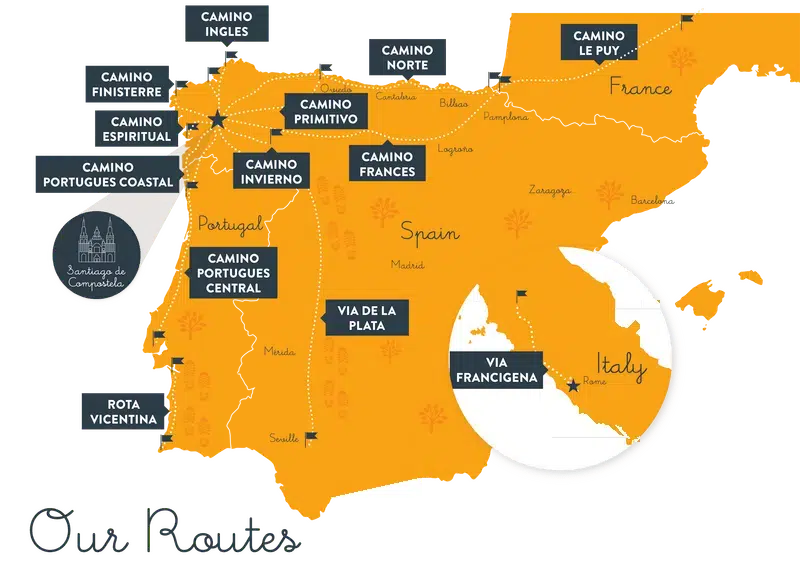
Choose your Camino route
There are 12 main Camino routes, from under 100 km to around 2,000 km. Most first-timers walk the last 100 km of one of the routes below, which takes about a week and earns the Compostela certificate.
Camino Francés
Sarria to Santiago: 111 km, about a week
The classic route, and the most sociable.
Camino Portugués
Tui to Santiago: about 119 km, 6–7 days
Culture, history and gentle walking.
Camino Portugués Coastal
Vigo to Santiago: about 100 km, 6–7 days
Atlantic views and seaside towns.
Camino del Norte
The last 100 km in Galicia: about a week
Green coast and fewer crowds.
Camino Inglés
Ferrol to Santiago: 119 km, 5–6 days
A short trip with a lot of history.
Camino Finisterre
Santiago to Fisterra: 90 km, 4–5 days
From Santiago on to the Atlantic.
Not sure which suits you? Read which Camino is best for a beginner.
Camino planning resources
When is the best time to walk?
Spring to autumn (April to October) suits most routes. July and August are the busiest months, while May, June and September bring milder weather and quieter paths.
How many days do I need?
The last 100 km into Santiago takes about a week of walking, the minimum to earn your Compostela. The full Camino Francés, 772 km from the French Pyrenees, takes 30 to 35 days.
How much does the Camino cost?
Budget pilgrims staying in albergues spend about €40 to €90 a day. A fully supported trip with hand-picked hotels and luggage transfers is about €100 to €180 a day.
Am I fit enough?
If you can walk for a few hours at a steady pace, you can walk the Camino. A few weeks of regular walks before you go makes every day on the trail more enjoyable.
Where do I sleep?
Pilgrims sleep in albergues (pilgrim hostels), family-run guesthouses, rural houses and hotels, including historic Paradores on some routes. Booking ahead takes the daily worry away, especially in summer.
Walking for the first time? Read Walking the Camino de Santiago: a beginner’s guide and avoid these common mistakes.
Pilgrim essentials
The pilgrim passport (credencial)
Your pilgrim passport is a small booklet you get stamped at churches, cafés and guesthouses along the way. Collect two stamps a day on the last 100 km.
The Compostela certificate
Walk at least the last 100 km into Santiago, or cycle the last 200 km, and the Pilgrim’s Office gives you the Compostela. Show your stamped passport when you arrive.
What to pack
Pack light: comfortable walking shoes you have already worn in, layers and a rain jacket. With luggage transfers, you only carry a small daypack.
Maps and waymarks
Yellow arrows and scallop-shell markers guide you all the way to Santiago. Our maps show each route and its stages.
Culture, food and history
The Camino is more than a walk. For over a thousand years, pilgrims have followed these paths to the tomb of Saint James, sharing bread, stories and songs along the way. Today you’ll find Romanesque churches, lively village festivals and some of the best food in Spain.
The history of the Camino
How a medieval pilgrimage became one of the world’s great walks.
Food and wine
From pulpo to Albariño: what you’ll eat and drink on the way.
Galician dishes
The local dishes pilgrims remember long after they get home.
Festivals and traditions
The fiestas and customs you may meet along the route.
Santiago de Compostela
The city at the end of every Camino, and what to see there.
Need a nudge? Read pilgrims’ own stories or watch our favourite Camino films.
Free Camino tools and resources
The Camino Planner
Pick your route, your dates and how far you’d like to walk each day. Our award-winning Camino Planner builds your personal itinerary in minutes, with distances for every stage.
Looking for more Camino resources, stories and news? Visit the Camino blog.
Walk the Camino with CaminoWays
For over 15 years, we’ve helped more than 50,000 pilgrims walk and cycle the Camino. We book your hotels, move your luggage each day and are on hand 24/7, so you can simply enjoy the journey.
Camino questions, quickly answered
What is the Camino de Santiago?
A network of historic pilgrim routes across Europe that all end at the cathedral in Santiago de Compostela, in north-west Spain. People walk or cycle it for faith, adventure, culture or a well-earned break.
Which Camino route is best for a first-timer?
The last 100 km of the Camino Francés, from Sarria, or the Camino Portugués from Tui. Both take about a week and are well waymarked.
How far do I need to walk to get the Compostela?
At least the last 100 km into Santiago on foot, or 200 km by bike, with two stamps a day in your pilgrim passport on that stretch.
Do I need to carry my luggage?
No. With luggage transfers, your bag goes ahead to your next hotel each day, so you walk with just a light daypack.
Can I cycle the Camino?
Yes. Several routes can be cycled, and e-bikes make the hills much easier.
If you’d like a personalised itinerary, try our award-winning Camino Planner.


