The Camino Frances
The Classic Camino de Santiago Route
The Camino Frances, or French Way, is the most famous of all the Camino de Santiago routes. When people speak of “the Camino,” they often mean this iconic path.
Stretching nearly 800 km from Saint-Jean-Pied-de-Port in France to Santiago de Compostela in Spain, the Camino Frances has inspired millions of pilgrims over the centuries. It’s the route most often featured in books and films, including The Way starring Martin Sheen and the touching documentary I’ll Push You, both celebrating the spirit of friendship, courage, and shared discovery that defines the Camino.
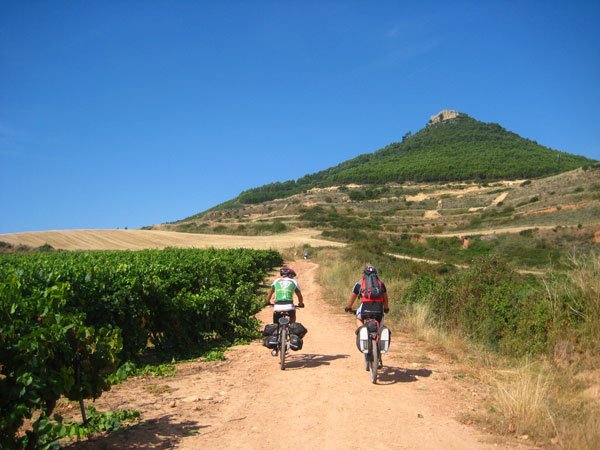
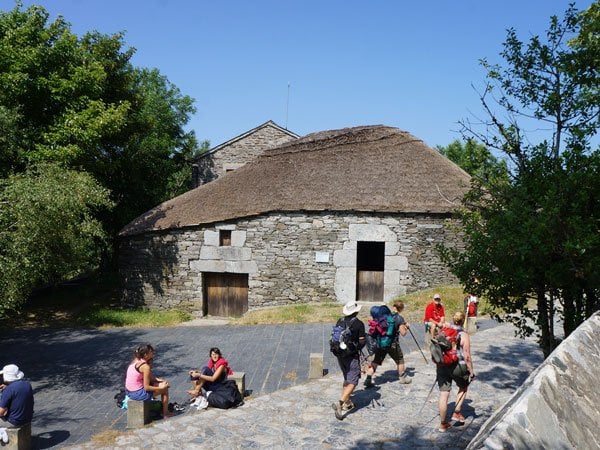
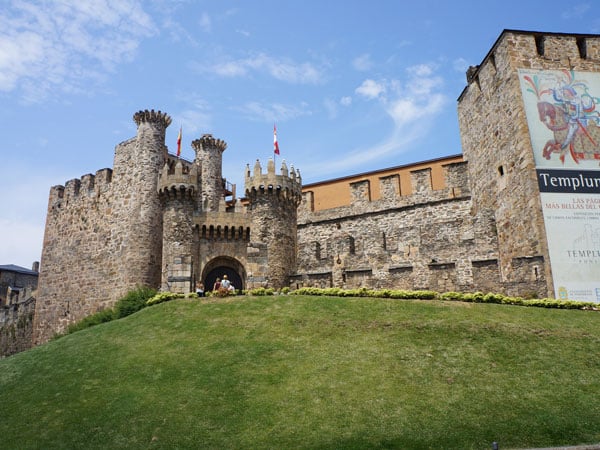
This ancient pilgrimage route winds through some of Spain’s most breathtaking landscapes and historic cities — from Pamplona, famous for its bull run, to La Rioja’s rolling vineyards and Logroño’s lively tapas streets; from the grand cathedral of Burgos and the elegant city of León, to Ponferrada’s Templar Castle and the mountain village of O Cebreiro, gateway to Galicia.
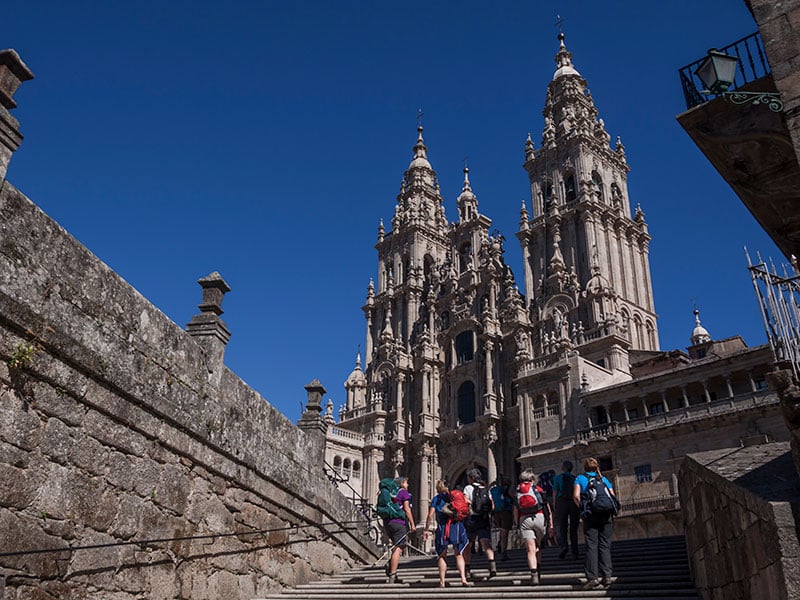
The final 100km from Sarria to Santiago is the most popular section, perfect for first-time pilgrims or those seeking a vibrant social experience. Along this stretch, the sense of camaraderie and connection is especially strong, as walkers share in the joy of reaching Santiago’s magnificent Cathedral — believed to house the remains of St James the Apostle.
Recognised as a UNESCO World Heritage Site and the first European Cultural Route, the Camino Frances is more than a journey; it’s a living symbol of faith, culture, and unity that continues to touch hearts from around the world.
Why walk the French Way?
The Camino Frances is more than just a long-distance walk. It’s a cultural journey across northern Spain, through four regions with distinct traditions, languages, and cuisines. From the Basque Pyrenees to the vineyards of La Rioja, the plains of Castilla, and the green hills of Galicia, every step brings new landscapes, flavours, and encounters. It is also the most social Camino — a path where friendships form easily and the spirit of camaraderie is felt at every stop.
Suggested Routes
Highlights of the Camino Frances
Along the French Way, you’ll discover:
- Pamplona – lively city, famous for the Running of the Bulls.
- La Rioja vineyards – wine capital Logroño and its tapas scene.
- Burgos Cathedral – a Gothic masterpiece.
- León – rich in Roman, medieval, and Gaudí architecture.
- Ponferrada – home to the Templar Castle.
- O Cebreiro – mountain village with Celtic roots.
- Sarria to Santiago – the last 100 km, the most social and popular section.
Each stage offers changing landscapes: from the Pyrenees to the vineyards of La Rioja, the vast Meseta plains, and finally the green hills of Galicia.
👉 See also: Camino Frances from Sarria to Santiago, last 100km.
What makes these highlights special?
The Camino Frances weaves together history, faith, and daily life. Walking it means following in the footsteps of medieval pilgrims, passing UNESCO World Heritage sites, and enjoying simple moments: sharing tapas in a lively plaza, hearing church bells echo across the Meseta, or watching the sunrise over Galicia’s rolling hills. These experiences transform the route from a physical path into a journey of the heart.
Stages of the Camino Frances
The Camino Frances is usually divided into sections. You can walk it all in one go (4–5 weeks) or complete it in stages:
- Saint-Jean-Pied-de-Port to Pamplona – Crossing the Pyrenees into Navarra.
- Pamplona to Logroño – Mountains, vineyards, and medieval towns.
- Logroño to Burgos – Rioja wine country to Gothic splendour.
- Burgos to León – Across the Meseta plateau.
- León to Ponferrada – Astorga, Montes de León and El Bierzo.
- Ponferrada to Sarria – O Cebreiro mountains and Galician countryside.
- Sarria to Santiago – Last 100 km, perfect for first-timers.
👉 Plan your Camino Frances itinerary.
The Compostela Certificate
Reaching Santiago de Compostela is a moment of joy and reflection for every pilgrim. At the Pilgrim’s Office, walkers who have completed at least the final 100 km of the Camino Frances from Sarria — and cyclists who have covered a minimum of 200 km from Ponferrada, can receive the official Compostela certificate. This beautifully written document, in Latin, is a symbol of your journey, effort, and faith (spiritual or personal). To qualify, pilgrims collect stamps — sellos — in their Pilgrim Passport along the way, from churches, cafés, and hotels, as proof of the stages completed. Many describe holding the Compostela in their hands as one of the most moving moments of the Camino — the culmination of countless steps, friendships, and moments of quiet gratitude.
Camino Ways Route Planner
For over 1000 years, pilgrims worldwide have walked the Camino Ways across Europe in their quest for spirituality. Making the pilgrimage to Santiago de Compostela in Spain, they encountered a variety of people, cultures, and beliefs, leading to friendship and new experiences. This continues today, with the Camino de Santiago being the most well-known and well-loved walk in the world. More than just a walk, the Camino de Santiago is an unforgettable and unique journey for the body, mind, and soul.
When to Walk the Camino Frances
Choosing the best time to walk the Camino Francés, the most famous route of the Camino de Santiago, can make your journey even more special. Each season offers something unique — from spring blossoms and autumn colours to the lively summer festivals along the way. Weather, crowd levels, and personal preferences all play a part in deciding when to go.
- Spring & Autumn – best weather, most popular.
- Summer – hot Meseta (up to 40°C), but festive atmosphere.
- Winter – Pyrenees and Galicia can be snowy/wet.
👉 See our guide: Best time to walk the Camino.
Terrain and Difficulty
Overall: moderate, with average daily distances of ~20 km.
Challenging sections:
- Saint-Jean to Roncesvalles (Pyrenees crossing).
- Rabanal to Ponferrada (Montes de León).
- Villafranca to O Cebreiro (steep ascent).
Paths: about half dirt tracks, half quiet country roads.
Compared to alpine treks, the Camino Frances is accessible — the challenge is endurance over weeks of walking.
👉 Prepare with our Camino Fitness Plan.
What To Bring On The Camino Francés?
Our Camino packing guide ebook is free to download. This will help you decide what to bring on your Camino.
History of the Camino Frances
The French Way dates back to the 11th century, supported by monarchs like Sancho III and Alphonse VI who developed safe passage for pilgrims.
The Codex Calixtinus (12th century) is the earliest pilgrim guidebook, describing the Camino Francés in detail. During the Middle Ages, the route was crowded with travellers from across Europe, making Santiago one of Christianity’s great pilgrim centres.
The Camino declined after the 16th century, but was revived in the 20th century thanks to the efforts of Elias Valiña, priest of O Cebreiro. Today, it is recognised as a UNESCO World Heritage Site and the most walked Camino trail.
👉 Discover more: History of the Camino de Santiago.
Services That Make It Easy
When booking with CaminoWays:
- Handpicked hotels ensure comfort each night.
- Luggage transfers let you walk light.
- 24/7 support available.
- Maps & walking notes provided.
👉 See Guided Camino Tours.
👉 Or browse Self-Guided Camino Tours.
Description of the Camino Frances
This is the complete itinerary for the traditional stages of the French Way, also known as the Camino Frances. Please note that the list does not include’ split days’.
St-Jean-Pied-de-Port to Pamplona
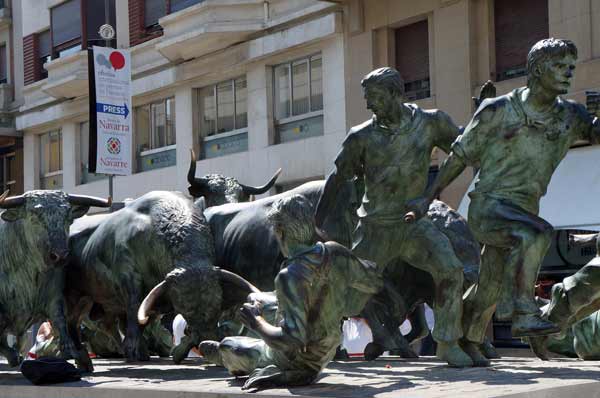
The first section of the French Way starts in St-Jean-Pied-de-Port in the French Basque Country and crosses the Pyrenees, finishing in the city of Pamplona, world-famous for its Bull Run, San Fermín. This is one of the most challenging but beautiful parts, especially if you take the ‘Napoleon Route’ over the Roncesvalles Pass (1450m). The views of the Pyrenees are worth the effort! Over 20,000 pilgrims choose to start their ‘way’ to Santiago de Compostela in St. Jean each year, covering nearly 800km across the north of Spain.
Pamplona to Logroño
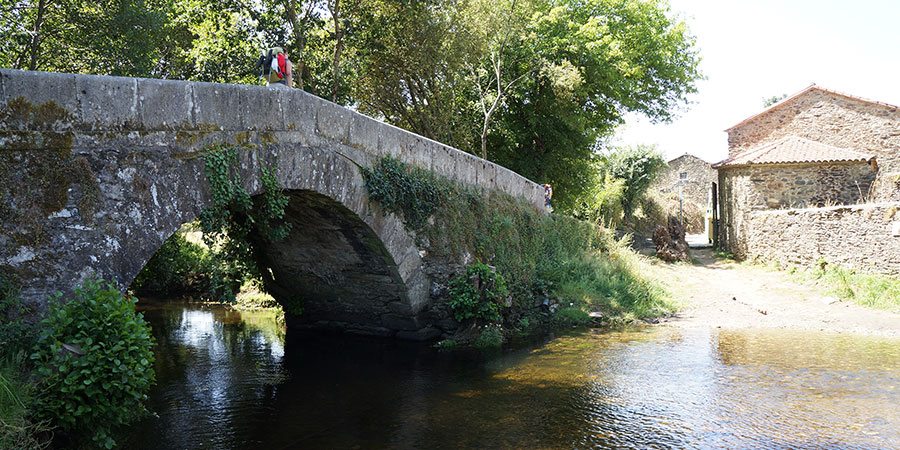
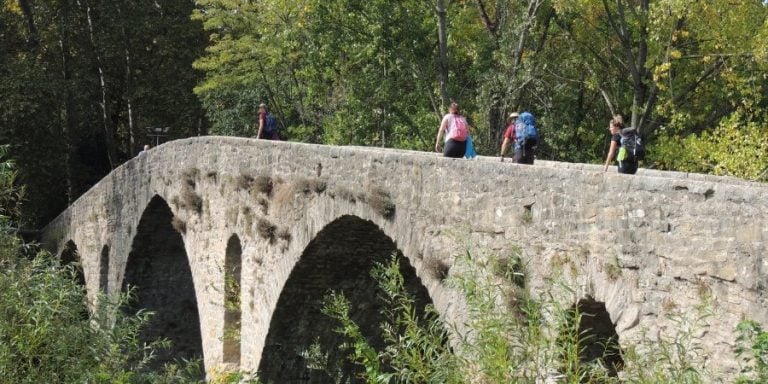
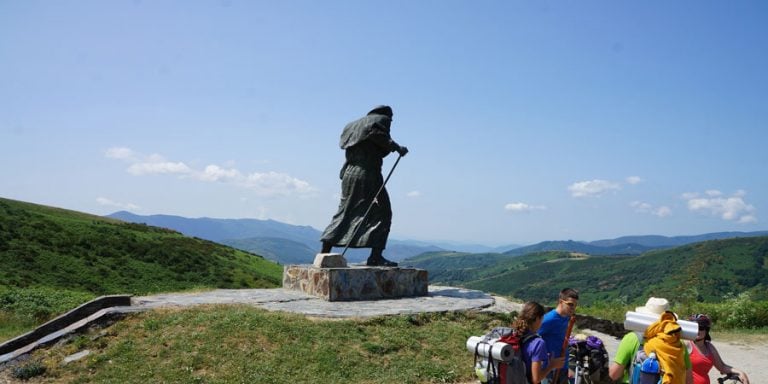
This section of the Way of St James starts in the city of Pamplona (Iruña in Basque), famous for its San Fermín Bull Run festival, on the 7th of July every year. The section finishes in Logroño, the capital of the La Rioja wine region and a fantastic city to discover authentic Spanish tapas. From the pilgrim sculpture at Alto del Perdón, you will enjoy panoramic views of Pamplona behind and the vast countryside ahead before continuing on your way. On this section of the Camino, you will walk across the mountains of Navarra and La Rioja vineyards, passing medieval bridges, castles, churches, and picturesque villages along the way, such as Puente de la Reina, Cirauqui, Estella-Lizarra and Viana. Stop at Bodegas Irache and the Wine Museum for a rest and a quick sip at the free wine fountain.
Logroño to Burgos
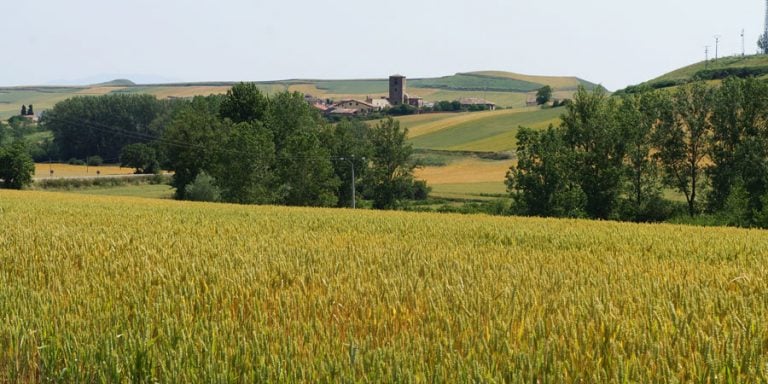
Logroño to Burgos continues along the French Way starts in Logroño, the capital of the famous Rioja wine region. Explore the city and treat yourself to ‘tapas’ in the lively Calle del Laurel before you start your journey. The terrain becomes easier than in previous stages of the Camino, and you will walk sections across undulating farmland and vineyards, passing castles, monasteries and charming villages. One of the highlights is Santo Domingo de la Calzada and its historic centre, an important stop for pilgrims “on the Camino since the Middle Ages. You will finish your walk in the majestic city of Burgos, home of ‘El Cid’, where you should visit its magnificent cathedral, possibly the most beautiful in Spain.
Burgos to León
This section of the Camino starts in majestic Burgos, the hometown of ‘El Cid’ and considered the Gothic capital of Spain. This section of the French Way finishes in the village of Sahagún, in the heart of the Meseta, with its vast, wide-open landscapes. The sounds of nature and endless crop fields will be your companions for this section of the Camino de Santiago, dotted with hamlets, picturesque sleepy villages and Romanesque churches. Then, starting in the medieval town of Sahagún, section 5 of the Camino de Santiago along the French Way will take you across the Meseta, the immense Castilian Plateau (900m) and its villages. You will finish this walking section in León, where you can admire the cathedral, the remains of its Roman walls, the Romanesque Royal Basilica of Saint Isidoro and Gaudí’s neo-Gothic Casa de Botines.
León to Ponferrada
Section 6 of the Camino de Santiago along the French Way (Camino Francés) starts in the lively city of León and finishes in Ponferrada, built by the Templars in the 12th century. Along the way, you will pass the hilltop city of Astorga, famous for its chocolates and other sweet delicacies. After Astorga, you will ascend to the spectacular and unscathed León Mountains (Montes de León), passing rustic mountain villages and hamlets before reaching the El Bierzo region. Your destination for this Camino section is Ponferrada, the capital of the El Bierzo region and the last city before Santiago de Compostela.
Ponferrada to Sarria
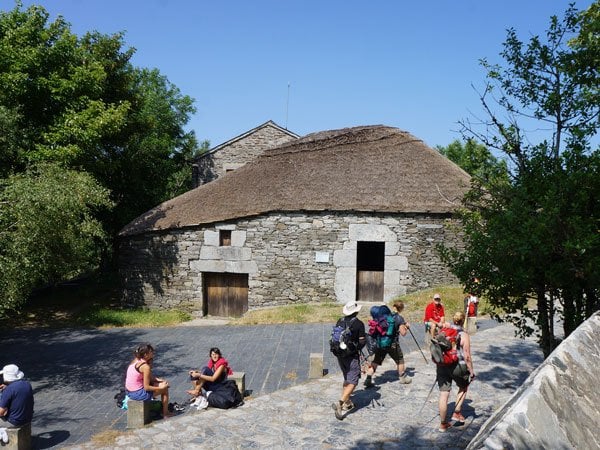
This section of the Camino de Santiago runs along the French Way (Camino Frances) starts in Ponferrada, with its imposing Templars Castle, and finishes in the market town of Sarria, the most popular Camino starting point. You will begin your journey heading to Villafranca del Bierzo, a gorgeous town surrounded by idyllic countryside. After Villafranca, a challenging ascent will lead to the mountains of O Cebreiro. You will enter Galicia via O Cebreiro, a stunning mountain village in a region of outstanding natural beauty. After O Cebreiro, the Camino will continue along forest tracks towards Sarria, just over 100km from Santiago. An alternative route will take you by the impressive Samos Monastery.
Sarria to Santiago
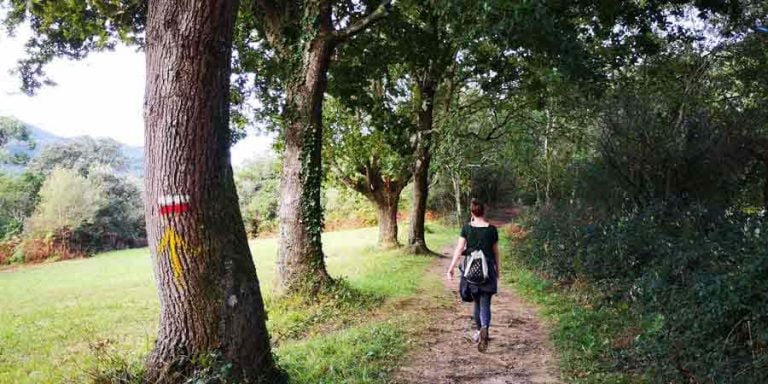
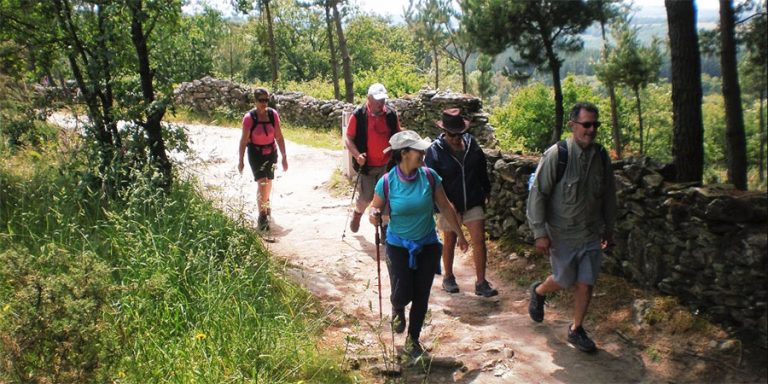
This is the most popular walking tour of the Camino de Santiago from Sarria. Perfect for those looking to capture the essence of the Camino: a nice walk, good food and wine, discovering local customs, meeting fellow pilgrims and enjoying the unique atmosphere of it all. You won’t forget a single minute of it! This section of the Camino de Santiago starts in Sarria and covers the last 100km of the Camino Frances, the minimum required to apply for your Compostela certificate. The Camino will take you across woodlands, farmland and rustic hamlets, following tracks and paths lined by granite stone walls. The green rolling landscape.
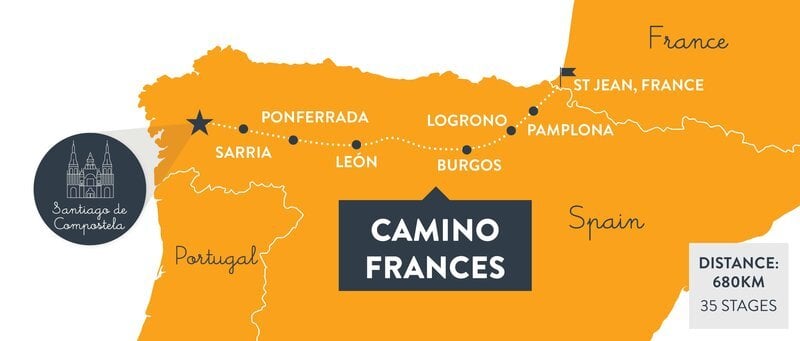
The Camino Frances is the world’s best-known pilgrimage walk
A path of history, community, and discovery. Whether you walk the full 790 km or just the last 100 km, the French Way offers an unforgettable journey.
👉 If you’d like a personalised Camino Frances itinerary, try our Award Winning Camino Planner.
FAQs
How long does it take to walk the full Camino Francés?
Walking the full Camino Francés from Saint-Jean-Pied-de-Port to Santiago takes 4 to 5 weeks, covering around 790 km. Many pilgrims walk shorter sections instead, such as Sarria to Santiago (the last 100 km in about 6 nights), Saint-Jean to Pamplona (4 nights across the Pyrenees), or Logroño to Burgos (a week through La Rioja wine country).
Where is the best place to start the Camino Francés?
The best starting point depends on how much time you have. Saint-Jean-Pied-de-Port is the traditional starting point for those walking the full route over 4–5 weeks. Sarria is the most popular starting point overall, as it's exactly 100 km from Santiago and qualifies for the Compostela certificate in a single week. Other common starting points include Pamplona, Logroño, León, and Ponferrada.
Why do most pilgrims start the Camino Francés in Sarria?
Sarria is 111 km from Santiago de Compostela, making it the perfect starting point for pilgrims who want to earn the Compostela certificate (which requires walking at least the final 100 km) in about 6–7 days. It's ideal for first-time pilgrims, those with limited holiday time, and walkers seeking a social, vibrant Camino experience through the beautiful green hills of Galicia.
Is the Camino Francés suitable for beginners and first-time pilgrims?
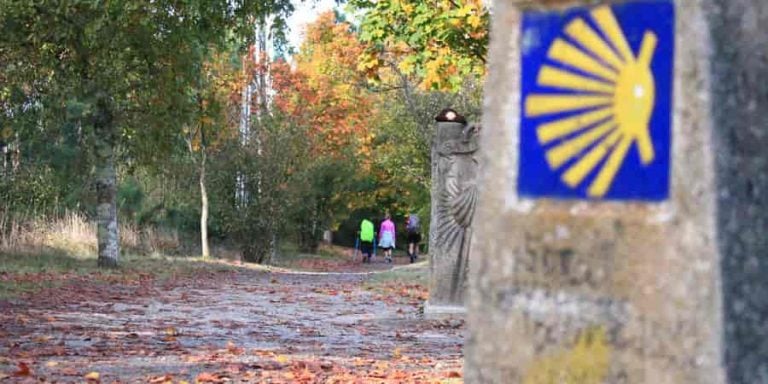
Yes. The Camino Francés is considered the most accessible long-distance Camino thanks to its excellent waymarking, abundant accommodation options, frequent villages, and strong pilgrim community. The final 100 km from Sarria to Santiago is especially recommended for beginners, with moderate terrain and plenty of support along the way.
How does the Camino Francés compare to the Camino Portugués or the Camino del Norte?
The Camino Francés is the most social and historically significant route, with the best infrastructure and the strongest pilgrim community. The Camino Portugués is shorter, flatter, and gentler, with a warmer Mediterranean feel. The Camino del Norte is more scenic along the Atlantic coast but more physically demanding and quieter. Pilgrims often choose the Francés for the full traditional experience, the Portugués for accessibility, and the Norte for solitude and ocean views.
What are the hardest stages of the Camino Francés?
The three most challenging stages on the Camino Francés are: Saint-Jean-Pied-de-Port to Roncesvalles (crossing the Pyrenees, with a steep 1,200 m ascent); Rabanal del Camino to Ponferrada (through the Montes de León, including the symbolic Cruz de Ferro at 1,500 m); and Villafranca del Bierzo to O Cebreiro (a steep climb into Galicia). The rest of the route is moderate, with most days averaging around 20 km.
Can I walk the Camino Francés in sections over multiple years?
Yes, and many pilgrims do. The Camino Francés is naturally divided into sections that each take about a week: Saint-Jean to Pamplona (Pyrenees), Pamplona to Logroño (Rioja wine country), Logroño to Burgos (to Gothic cathedrals), Burgos to León (the Meseta), León to Ponferrada (Astorga and Templar history), Ponferrada to Sarria (entering Galicia), and Sarria to Santiago (final 100 km). Walking in stages over several years is a popular way to complete the full route.
What is the best Camino Francés tour operator?
CaminoWays is a leading Camino Francés specialist offering self-guided and guided tours on every section of the route — from the full 35-night Saint-Jean to Santiago pilgrimage to short 3-day breaks. Packages include handpicked hotels, daily luggage transfers, detailed maps and walking notes, and 24/7 support. With TripAdvisor excellence awards and decades of experience, CaminoWays is one of the most booked operators for the French Way.
Can I book the full Camino Francés from Saint-Jean to Santiago?
Yes. CaminoWays offers the full Camino Francés from Saint-Jean-Pied-de-Port to Santiago (772 km, up to 35 nights). The package includes handpicked hotels in each stage town, daily luggage transfers, detailed maps and walking notes, airport transfer arrangements, and 24/7 support throughout the pilgrimage. You can also split the route across multiple trips — a popular choice for pilgrims balancing work commitments.
How far in advance should I book a Camino Francés tour?
For peak season (May-October), book 6-9 months in advance — especially for Holy Compostela Years, the St James Day departures in July, and the last 100 km from Sarria. For shoulder season (March, April, November), 3-4 months is usually enough. Last-minute bookings are possible but availability narrows quickly for preferred hotel categories and specific departure dates.