
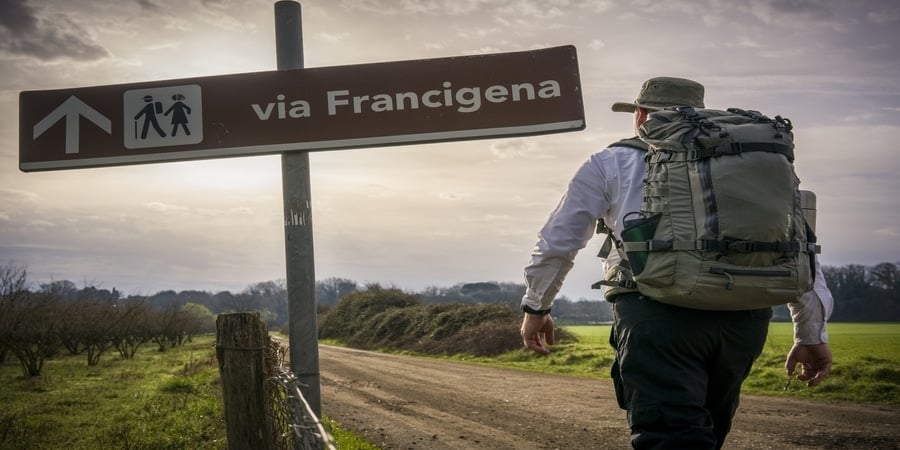
For over a thousand years, pilgrims have walked to Rome. Not driven, not sailed — walked. Through the Alps, across the plains of Tuscany, down through the medieval towns of Lazio, and finally into the Eternal City itself. The Via Francigena is the route they followed, and it remains today one of the great pilgrimages in Europe — a journey of landscape, history, and something harder to name that happens to people who travel slowly and on foot towards a place that matters to them.
Table of contents
- What Is a Pilgrimage to Rome?
- What is the Jubilee?
- Why The Via Francigena? A Path to Rome
- A Spiritual Journey on Foot
- The Route through Italy
- Spiritual Highlights of the Via Francigena
- The Testimonium: Arriving as a Pilgrim
- The Significance of Pilgrimage Today
- Choosing Your Route
- Preparing for the Pilgrimage
- Why Walk to Rome?
- FAQ: Pilgrimage to Rome on the Via Francigena
What Is a Pilgrimage to Rome?
Rome has been a destination for Christian pilgrims since the earliest centuries of the Church. The city holds the tombs of the Apostles Peter and Paul — the two figures most closely linked with the founding of Christianity in the West — and from the fifth century onwards, the journey to Rome was known as ad limina apostolorum: to the threshold of the apostles.
In the Middle Ages, the three great pilgrimages of Christianity were to Jerusalem, to Santiago de Compostela in Spain, and to Rome. Pilgrims travelling to Rome carried a key as their symbol — as those going to Santiago carried a shell, and those going to Jerusalem a cross. The Via Francigena was the main road that brought northern European pilgrims south across the Alps and through Italy to the gates of the city.
That tradition never disappeared. It has waxed and waned over the centuries — disrupted by wars, revivals, and the long period when Rome was overshadowed by Santiago as Christendom’s most popular pilgrim destination — but the impulse to walk to Rome has always returned. Today, with the Via Francigena formally recognised as a European Cultural Route, it is experiencing a genuine renaissance.
What is the Jubilee?
The Jubilee is a special event declared by the Pope, inviting Christians to focus on spiritual reflection. During the Holy Year, pilgrims are encouraged to seek forgiveness, undergo spiritual renewal, and strengthen their faith. The tradition dates back to the 14th century when Pope Boniface VIII declared the first Holy Year in 1300.
The effect was extraordinary. In 1300, an estimated 200,000 pilgrims made their way to Rome at a time when the entire population of Europe was a fraction of what it is today. The Via Francigena became one of the main arteries feeding this flood of people southward from France, Switzerland, and northern Italy.
An Ordinary Jubilee is declared every 25 years. The most recent was 2025 — themed Pilgrims of Hope — and the next Ordinary Jubilee will be in 2050. But the Church also declares Extraordinary Jubilees for specific occasions, and the spiritual value of walking to Rome as a pilgrim exists entirely independently of any official Holy Year. Pilgrims have always walked to Rome. The Jubilee simply gives a particular year an added layer of meaning.
Why The Via Francigena? A Path to Rome
The Via Francigena is not just a walking route that happens to end in Rome. It is the route, the one documented by Sigeric the Serious, Archbishop of Canterbury, when he walked from Rome to Canterbury in 990 AD and recorded his 79 stopping points along the way. His notes became a map that pilgrims used for centuries, and the path he described is essentially the one that walkers follow today.
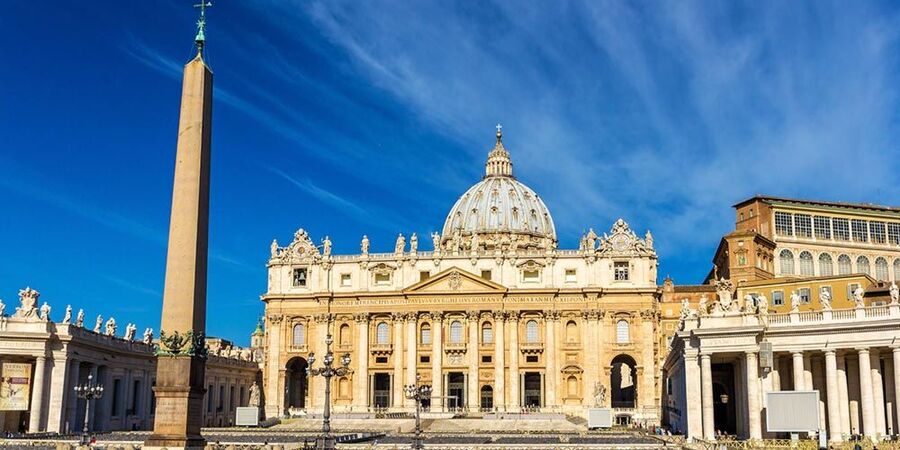
What makes it different from other long-distance routes is its destination. The Camino de Santiago ends at the tomb of an apostle in northwest Spain. The Via Francigena ends at the heart of Christendom — St Peter’s Basilica, built over the tomb of the first pope, in a city that has been the centre of Western spiritual life for two millennia. For pilgrims of faith, the weight of that arrival is different in kind, not just degree.
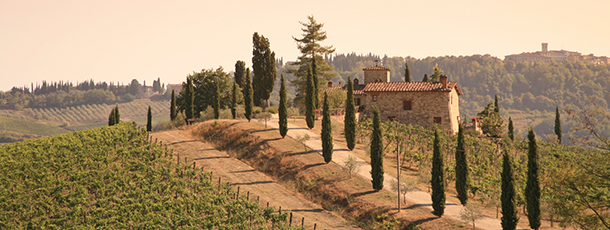
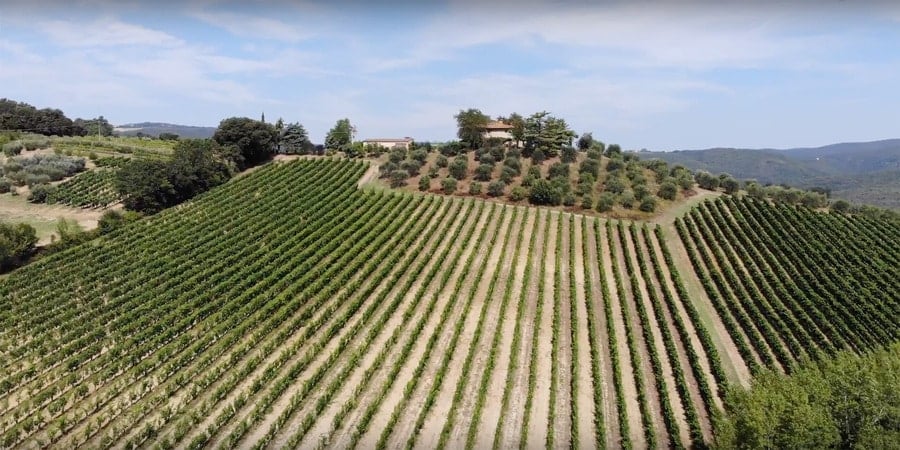
But the route also rewards those who walk it for reasons that have nothing to do with religion. The landscapes it passes through, the Swiss Alps, the rolling hills of Tuscany, the volcanic countryside of Lazio, are among the finest walking terrain in Europe. The towns along the way — Lucca, San Gimignano, Siena, Viterbo — are places of genuine beauty and history. And the simple act of walking slowly through a landscape, day after day, does something to a person that faster forms of travel simply don’t.
A Spiritual Journey on Foot
The sacred dimension of the Via Francigena is woven into the landscape rather than set apart from it.
- The Great St Bernard Pass — crossed in summer when the snow has melted — sits at 2,469 metres and has been used by pilgrims, armies, and merchants for two thousand years. The monastery at the summit has been offering shelter to travellers since the 11th century and still operates today.
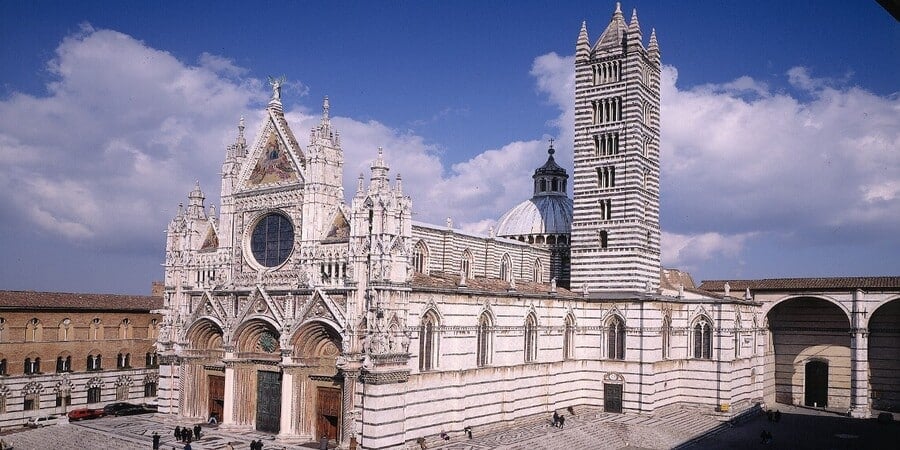
- The Siena Cathedral sits directly on the route through the city. Its extraordinary marble floor — one of the finest in Italy, depicting biblical scenes in intricate inlay — and its Gothic facade are encountered not as a detour but as a natural part of the day’s walking.
- The Etruscan ruins at Sutri, carved directly into the volcanic rock of Lazio, predate Christianity by centuries. Walking through them on the approach to Rome is a reminder that this road carried not just pilgrims but all the traffic of Western civilisation for two millennia.
- The thermal springs at Viterbo, where popes once took the waters after the arduous journey from Rome, still flow. The city’s medieval papal quarter, where the papacy resided for much of the 13th century, is one of the most atmospherically intact in Italy.
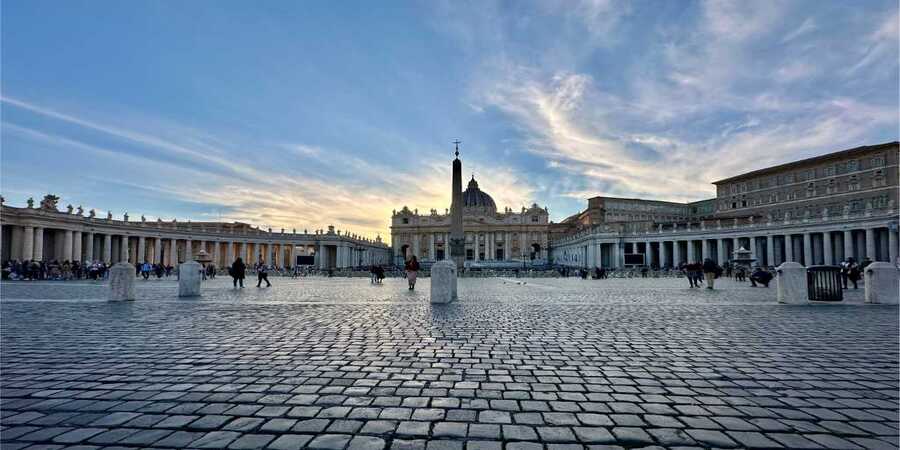
- Rome itself. The approach into the city on foot, along the Via Triumphale, past the Castel Sant’Angelo, into the great open space of St Peter’s Square, is one of the most powerful arrivals in pilgrimage anywhere in the world. The scale of it, after days of quiet countryside and small towns, hits differently when you’ve walked there.
The Route through Italy
The Via Francigena winds through some of Italy’s most beautiful landscapes. From the mountains of the Aosta Valley to the rolling hills of Tuscany, the route offers breathtaking views at every turn. Pilgrims pass through towns like San Gimignano, Siena, and Viterbo before finally arriving in Rome.
The Via Francigena offers various routes for the 2025 Jubilee pilgrimage, from the full journey from Lucca to Rome to shorter sections like the scenic Lucca to Siena stretch in Tuscany. Pilgrims can also enjoy Easy Walking from San Miniato to Siena or take the final sacred path from Viterbo to Rome.
Each town offers its unique charm and history. Pilgrims can enjoy local cuisine, visit medieval churches, and rest in peaceful surroundings. The Italian section of the Via Francigena is particularly rich in culture and tradition.
Spiritual Highlights of the Via Francigena
As pilgrims walk the Via Francigena, they encounter many sacred and historical sites. One of the most significant is the Great St Bernard Pass, a high mountain pass in the Alps. Pilgrims have used this crossing for centuries, and it offers stunning views of the surrounding peaks.
In Italy, pilgrims often stop at the Siena Cathedral, a masterpiece of Gothic architecture known for its intricate marble floors and stunning frescoes. Another key stop is Viterbo, a city with deep religious roots and home to the Papal Palace.
Of course, the ultimate spiritual highlight is arriving in Rome. St. Peter’s Basilica, with its magnificent dome and sacred relics, is the final destination for many pilgrims. The joy of reaching this holy place after weeks of walking is indescribable.
The Testimonium: Arriving as a Pilgrim
The Testimonium is the official certificate awarded to pilgrims who walk at least the last 100 km of the Via Francigena into Rome — the equivalent of the Compostela on the Camino de Santiago. To receive it, you carry a pilgrim passport and have it stamped in hotels, churches, monasteries, and restaurants along the way. On arrival in Rome, you present it at the designated office and receive your certificate.
For pilgrims walking in a Jubilee year, the Testimonium carries additional spiritual significance within the Catholic tradition. But it matters outside Jubilee years too — as the formal recognition of a journey made on foot, in the tradition of pilgrims who have been doing exactly the same thing for over a thousand years.
The Viterbo to Rome section is the most popular route for pilgrims specifically seeking the Testimonium. At 112 km it comfortably exceeds the 100 km minimum, fits into a week, and delivers the full emotional arc of the arrival in Rome.
The Significance of Pilgrimage Today
In modern times, pilgrimages have gained renewed interest. For many, the idea of slowing down, disconnecting from daily life, and walking in the footsteps of past pilgrims appeals. The Via Francigena offers a unique opportunity to explore not just physical landscapes but spiritual ones as well.
Pilgrimage allows people to reconnect with their faith, reflect on life’s challenges, and find inner peace. It’s an ancient practice that is still relevant in today’s fast-paced world. For the Jubilee in 2025, countless pilgrims will walk the Via Francigena, seeking meaning and spiritual renewal.
Choosing Your Route
The Via Francigena perfectly blends history, spirituality, and natural beauty. As pilgrims walk this ancient path, they will follow in the footsteps of countless others who have made the journey to Rome. The route offers a sense of continuity, connecting past and present.
- The Italian section of the Via Francigena offers several starting points depending on how much time you have and how complete a pilgrimage you want to make.
- Full Via Francigena from Lucca to Rome — 419 km, up to 20 nights. The complete Italian pilgrimage, from the walled city of Lucca all the way to St Peter’s Square. The most immersive and demanding option — and the most rewarding.
- Viterbo to Rome — Last 100km — 112 km, 6 nights. The most popular option for pilgrims focused on the arrival in Rome and the Testimonium. Fits into a single week and covers the most historically significant final approach to the city.
- Via Francigena in Tuscany from Lucca to Siena — 133 km, 7 nights. The classic Tuscany section for those who want the landscape and cultural experience of the route without committing to the full journey to Rome — with the option to continue south in a future trip.
- Cycling the Via Francigena from Lucca to Rome — 419 km, 11 nights. The full Italian route by bike, covering the same ground as the walking route in a more compact timeframe.
For help choosing the right starting point, see our guide to the best starting points on the Via Francigena.
Preparing for the Pilgrimage
Walking to Rome is a physical undertaking as much as a spiritual one and the two are not unrelated. The discipline of preparing your body, the daily routine of the trail, the stripping away of ordinary life that happens when you walk for hours through open landscape: these are part of what makes a pilgrimage a pilgrimage rather than a walking holiday.
Practically speaking, the preparation that matters most is breaking in your footwear well before departure, building fitness gradually in the months beforehand, and packing significantly less than you think you need. Our free Via Francigena beginner’s ebook covers the practical details in full.
For timing, spring and autumn are the best seasons for the Italian sections with the Alpine crossing reserved for July and August. For the full guide to when to walk, see our best time to walk the Via Francigena guide.
Why Walk to Rome?
The question answers itself differently depending on who you ask.
For pilgrims of faith, walking to Rome, in a Jubilee year or any other, is an act of devotion that connects them to seven centuries of pilgrims who made the same journey for the same reasons. The physical difficulty of the walk is part of its meaning, not incidental to it.
For others, it is the landscape, the particular beauty of Tuscany walked slowly over several days, the medieval towns at the end of each stage, the dinner in a farmhouse kitchen with a glass of local wine.
For others still, it is the time. The Via Francigena gives you days of walking and thinking in a way that ordinary life rarely permits. Something clarifies on a long walk that stays stubbornly unclear at a desk.
Most pilgrims, asked why they walked to Rome, give all three answers.
Whether you’re planning to walk the full length or just a section, the Via Francigena offers a pilgrimage experience like no other. Prepare yourself physically and spiritually, and let the path guide you to a deeper understanding of faith and hope.
For more information on Via Francigena or Guided walking tours or to book your Italian adventure, feel free to contact us.
FAQ: Pilgrimage to Rome on the Via Francigena
Do I have to be Catholic to walk the Via Francigena as a pilgrimage?
No. The Via Francigena welcomes walkers of all faiths and none. Many people walk it for cultural, personal, or physical reasons. The route’s spiritual dimension is available to anyone who wants to engage with it and easy to set aside for those who don’t.
What is the Jubilee and when is the next one?
The Jubilee is a Holy Year declared by the Catholic Church every 25 years, offering pilgrims who travel to Rome a plenary indulgence. The most recent Ordinary Jubilee was 2025. The next is 2050. Extraordinary Jubilees can also be declared for specific occasions between Ordinary ones.
What is the Testimonium and how do I get it?
The Testimonium is the pilgrim certificate awarded in Rome to those who have walked at least the last 100 km of the Via Francigena on foot. You need a stamped pilgrim passport throughout your journey. The Viterbo to Rome section (112 km, 6 nights) is the most popular way to qualify.
How long does it take to walk to Rome on the Via Francigena?
The full Italian section from Lucca to Rome takes up to 20 nights on foot. Most pilgrims walk it in sections over multiple trips. The shortest section that qualifies for the Testimonium is Viterbo to Rome — 6 nights and 112 km.
Is the Via Francigena busy during a Jubilee year?
Numbers are still modest compared to the Camino de Santiago, around 2,000–3,000 walkers per year in normal years, with higher numbers during Jubilee years. The route itself never feels crowded. Accommodation in Rome, however, fills significantly during Jubilee years and should be booked very early.
Where can I find more information on planning the walk?
Start with our free Via Francigena beginner’s ebook, our stages guide, and our best time to walk guide. Or use the Camino Planner to start building your itinerary.
