
The best Camino route for most first-time pilgrims is the last 100 km of the Camino Francés (Sarria to Santiago), walkable in 5-7 days and qualifying for the Compostela. For ocean views, choose the Camino Portugués Coastal from Porto. For solitude, the Camino Primitivo or Camino Invierno. For experienced walkers, the Camino del Norte or the full Camino Francés. CaminoWays offers self-guided, guided and cycling options on every route below.
The Camino de Santiago is not just a single trail. In fact, there are many different Camino routes to choose from. Starting from different points across Europe, pilgrims travelled to Santiago de Compostela in northern Spain. The most popular countries where pilgrims came from were France, Portugal, and different parts of Spain. From these destinations, many different Camino ways were formed.
Today, you can walk the many different routes of the Camino at your own pace, alone or with on a guided group tour. The choices are endless. You can even cycle the Camino by regular bicycle or by e-bike. The most important question you need to answer is which Camino route you should choose.
So, which Camino should you choose? Each Camino route has its own history and uniqueness.
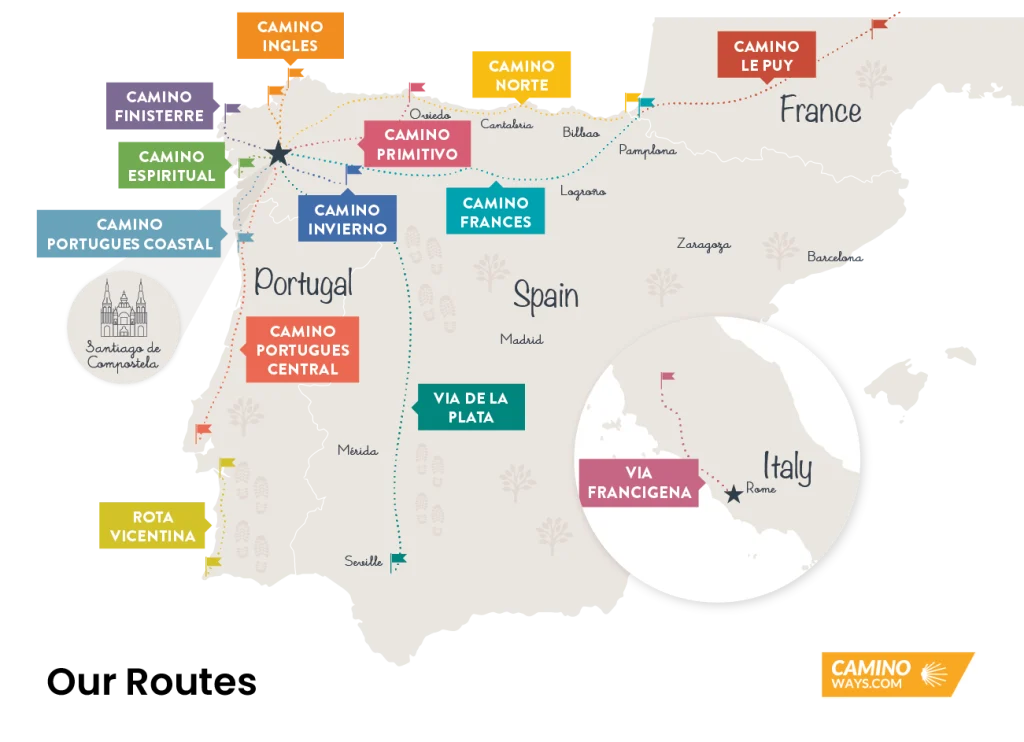
The beauty of the Camino is that there are many routes to choose from and you can start at any point, making it as short or long as you like.
Table of contents
- Our Camino Routes
- Camino Frances
- Camino del Norte: along the Northern Coast
- Camino Primitivo, or Original Way
- The Camino Ingles
- Camino de Fisterra
- Camino de Invierno (Winter Way)
- Via de la Plata
- Portuguese Coastal Camino
- Camino Portugues Espiritual (Spiritual Variant)
- Camino Portugués Central
- Le Puy Camino
- Rota Vicentina (Portugal)
- Via Francigena (Italy)
- Choose Your Camino: how to find the route that’s right for you
Our Camino Routes
Camino Frances
From Saint Jean Pied de PortThe Camino Frances first section starts in France, in Saint Jean Pied de Port, and immediately crosses the border into Spain after only 13km till you reach Roncesvalles after 26km. From Saint Jean Pied de Port, it takes 3 walking days to reach Pamplona and 7 walking days to reach Logrono. From there you are on the most famous Camino, the Camino Frances or French Way, featuring in movies such as Martin Sheen’s The Way and books such as Paulo Coelho The Pilgrimage. The Camino Frances starts in the French Pyrenees and crosses the La Rioja wine region, passing fantastic cities such as Pamplona and Burgos, before reaching the stunning mountains of León, the Templars Castle of Ponferrada and finally Galicia across the wonderful O Cebreiro mountains.
The Last 100km: From Sarria to Santiago
The last 100km of the Camino Frances route is the classic Camino experience. This is the most popular stretch as you can get your certificate in Santiago and it can be completed in just a week. You will walk from Sarria to Santiago de Compostela across the green Galician countryside, meeting many pilgrims along the way.
Camino del Norte: along the Northern Coast
The Camino del Norte, or Northern Way, is another stunning coastal Camino: it starts in chic San Sebastian, in the Basque Country, and follows the lush Northern coast of Spain into Cantabria and Asturias. You will get the chance to sample the region’s delicious cuisine and go for a swim in one of the many beaches along the way.
Camino Primitivo, or Original Way
The Camino Primitivo is the oldest and first Camino route. This is a mountainous and more challenging Camino route, starting in the city of Oviedo and crossing the mountains of Asturias into Galicia. You will get rewarded with peaceful and magnificent views. Highlights also include the city of Lugo to Santiago with its spectacular UNESCO Roman wall.
The Camino Ingles
The Camino Ingles is the route traditionally taken by pilgrims from Britain and Ireland who would have arrived by boat to the Northern shores of Galicia and continued on foot towards Santiago de Compostela. This is a short Camino, starting in the port cities of Ferrol or A Coruña. Along the way, you will stop in lovely historic towns such as Pontedeume and Betanzos.
Camino de Fisterra
To the end of the world!The Camino Finisterre Way is the only route starting in Santiago and takes pilgrims to the ‘end of the world’, Cape Fisterra, on the rugged and beautiful Atlantic Coast. The Cape, on the Costa da Morte, has a mystical allure for pilgrims. We recommend you continue to Muxia to admire its sanctuary and fascinating ‘magic rocks’.
Camino de Invierno (Winter Way)
It was traditionally used to avoid the snow-covered peaks of O Cebreiro on the Camino Francés. Starting in Ponferrada, this quieter route passes through vineyards, river valleys and rural villages of Galicia. It’s a wonderful alternative for pilgrims looking for solitude, authenticity, and a less crowded Camino experience.
Via de la Plata
The Via de la Plata is the Camino for adventurers, the road less travelled. The trail starts in the fascinating Andalucian city of Seville and heads North across rural landscapes but also passing beautiful historic cities or wonderful culture and rich Roman heritage such as Merida, Salamanca and Ourense.
Portuguese Coastal Camino
Porto to SantiagoThe Portugues Coastal Camino is quickly becoming a favourite, particularly for the summer months. Starting in wonderful Porto, the route takes pilgrims along the Atlantic Ocean, stopping in seaside villages on the way. The route takes in the scenic shores of Northern Portugal and the Rias Baixas in Galicia.
Camino Portugues Espiritual (Spiritual Variant)
The Camino Espiritual is a beautiful and symbolic variant of the Camino Portugués. It follows the final journey of Saint James’ remains by land and sea.
Starting in Pontevedra, pilgrims walk through peaceful Galician countryside before boarding a boat across the Ría de Arousa, retracing the legendary maritime route to Padrón, before continuing on foot to Santiago. This Camino is ideal for those seeking a deeper spiritual and reflective experience.
Camino Portugués Central
The Camino Portugués Central is the classic inland route from Lisbon or Porto to Santiago de Compostela.
Passing through historic cities like Coimbra, Tui and Pontevedra, this Camino offers a rich mix of culture, history and welcoming pilgrim communities. It’s a great option for first-time pilgrims looking for good infrastructure with fewer crowds than the Camino Francés.
Le Puy Camino
A classic French route to Santiago. The Le Puy Camino is a truly spectacular trail, starting in Le Puy-en-Velay in the heart of France with its imposing cathedral and volcanic landscapes. Le Puy Way is the most popular Camino route in France and a classic trail, passing some of France’s most beautiful towns such as Conques, Cahors and the picturesque Lot Valley. It is also known as Via Podiensis.
Rota Vicentina (Portugal)
While not a Camino route to Santiago, the Rota Vicentina is an incredible long-distance walking trail in southern Portugal and is often chosen by pilgrims and walkers looking for a coastal nature-focused journey.
Running along dramatic Atlantic cliffs and unspoiled beaches, it’s ideal for those who love sea views, quiet paths and walking at a slower, more contemplative pace.
Via Francigena (Italy)
Choose Your Camino: how to find the route that’s right for you
Choosing your Camino is a personal decision. There is no single path that suits everyone — and that’s the beauty of the Camino de Santiago. With so many routes, landscapes, and experiences, you can truly choose your Camino based on what you need right now in your life.
Here are a few simple questions to help you decide.
How much time do you have?
- If your time is limited, shorter routes are a great way to experience the Camino without rushing. Our 100km Walking Collection is perfect for those who want the classic Camino experience and still qualify for the Compostela certificate. These routes can usually be completed in about a week and are ideal for first-time pilgrims.
- If you prefer cycling, our 200km Cycling Collection allows you to experience the Camino at a faster pace while still enjoying the landscapes, culture, and sense of achievement that define the journey.
- If you have more time available, you may prefer a longer Camino such as the Camino Francés from Saint-Jean-Pied-de-Port or the Camino Portugués from Porto or Lisbon, where the journey unfolds more gradually, day by day.
What landscapes inspire you?
Your surroundings shape your Camino experience.
- Walk or cycle by the ocean on the Camino Portugués Coastal or the Camino del Norte.
- Enjoy mountains and quiet paths on the Camino Primitivo or the Camino de Invierno.
- Experience history, vineyards, and iconic towns on the Camino Francés or the Via de la Plata.
Do you want company or solitude?
Some pilgrims love the shared experience of walking with others, while others prefer peace and reflection.
- For a social Camino, choose the Camino Francés or the Camino Portugués.
- For a quieter Camino, the Camino Primitivo, Camino Inglés or Camino de Finisterre may suit you better.
Walking or cycling your Camino?
The Camino can be walked or cycled, depending on your pace and preferences. Cycling the Camino allows you to see more in less time while still embracing the Camino spirit.
Frequently Asked Questions about choosing your Camino
For most first-time pilgrims, the last 100 km of the Camino Francés (Sarria to Santiago) is the best choice. It takes 5-7 days, has excellent infrastructure, clear waymarking, and qualifies you for the official Compostela certificate. The Camino Portugués from Porto is the second most popular choice for beginners.
The Camino Portugués Coastal from Porto and the last 100 km of the Camino Francés are the easiest Camino routes for most walkers. Both have gentle terrain, well-maintained paths, plenty of cafés and accommodation, and short daily distances (around 20 km). CaminoWays’ Easy Walking Collection averages 10-15 km per day.
This is subjective, but pilgrims often name the Camino del Norte for its dramatic Atlantic coastline, the Camino Primitivo for its mountain landscapes, and the Camino Portugués Coastal for its mix of beaches and forests. The Camino Francés is most famous for its variety — Pyrenees, Rioja vineyards, Meseta plains, and Galician hills.
The Camino Invierno, Via de la Plata and Camino Primitivo are the quietest Camino routes, with very few pilgrims compared to the busy Camino Francés. The Camino Inglés is also relatively quiet outside the peak summer months.
With one week available, the best options are the last 100 km of the Camino Francés (Sarria to Santiago), the Camino Inglés from Ferrol, the final stage of the Via de la Plata from Ourense, or the Camino Finisterre from Santiago. All four can be walked in 5-7 days.
The Camino Francés is the best Camino for solo travellers thanks to its sociable atmosphere — you’ll easily meet fellow pilgrims along the way. The Camino Portugués Central is also excellent for solo walkers. CaminoWays also runs guided group tours, including a women-only Camino Francés departure, ideal for solo travellers preferring company.
The last 100 km of the Camino Francés from Sarria is the most popular choice for older walkers, with good infrastructure, manageable terrain and short daily distances. CaminoWays’ Easy Walking Collection is also designed for shorter days of 10-15 km on gentler terrain.
The Camino Francés is the most popular and historic route, crossing northern Spain from the French Pyrenees with diverse landscapes and a sociable atmosphere. The Camino Portugués is shorter, quieter and offers a coastal variant from Porto with ocean views. Both have excellent infrastructure for first-time pilgrims.
Yes. Popular combinations include the Camino Portugués + Camino Finisterre, the Camino Francés + Camino Finisterre to the Atlantic coast, and the Camino Inglés + Camino Finisterre. CaminoWays travel specialists can build custom itineraries combining any routes.
The Camino de Santiago is not about choosing the most popular route or walking the longest distance. It’s about choosing the path that fits your time, your pace and your reasons for walking.
When you take the time to choose your Camino, you are already beginning the journey — step by step, with intention.
👉 If you’d like a personalised itinerary, try our Award Winning Camino Planner
https://caminoways.com/camino-de-santiago-planner
I hope this article helped you with which Camino Should I Choose? You might also like to read our blog posts:
For more information about the Camino de Santiago routes, contact us.
