

Like the Camino de Santiago, the Via Francigena is a historic pilgrimage route. It begins at Canterbury Cathedral in the UK and leads all the way to Rome, known as the Eternal City. Spanning 1,900 km, the route traces the path taken by Sigeric the Serious, the Archbishop of Canterbury, who made this pilgrimage to Rome in the 10th century and documented his journey in a diary. This ancient trail allows pilgrims to follow in historic footsteps across Europe, culminating in Rome.
Unlike many modern long-distance trails, the Via Francigena was not designed, it was walked into existence. For centuries, pilgrims, merchants, soldiers, and clergy followed this same corridor through the heart of medieval Europe, connecting the Christian world from the north of England to the spiritual centre of Rome.
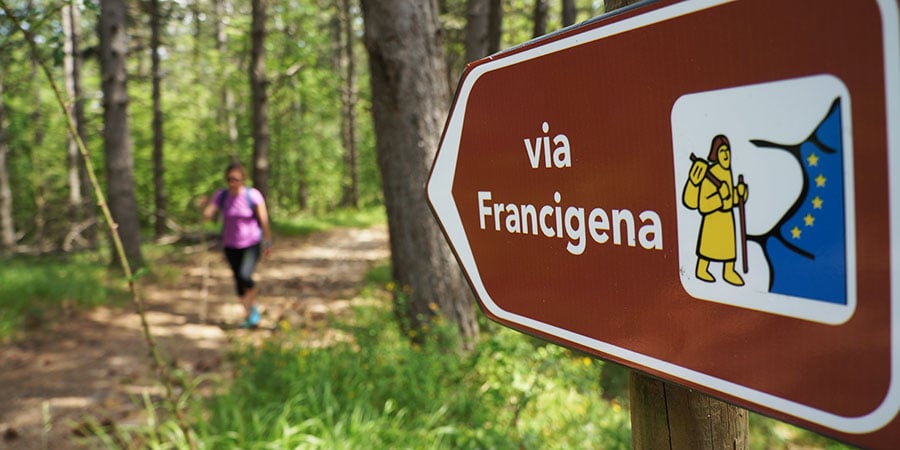
Walking the full Via Francigena from Lucca to Rome takes about three weeks while cycling the full route takes up to 11 nights. However, many pilgrims choose to complete sections of the full Via Francigena over a few days or weeks.
The Story of Sigeric the Serious
The route as we know it today owes its name and direction to a single remarkable document. In 990 AD, Sigeric the Serious — Archbishop of Canterbury — made the pilgrimage to Rome to receive his pallium from Pope John XV. On his return journey, he recorded every stopping place along the way: 80 stages in total, written in a travel diary that still exists today.
That diary is the oldest known itinerary of the Via Francigena, and it remains the primary historical reference for the route. To learn more about how the path evolved over the centuries, read our full History of the Via Francigena. Pilgrims who walk “the Via Francigena according to Sigeric” are following, almost step for step, a path that has not fundamentally changed in over a thousand years.
The name itself reflects the route’s origins: Via Francigena means “the road that comes from the land of the Franks” — the name Italians gave to the path arriving from northern Europe.
Why People Walk the Via Francigena Today
People come to this route for many different reasons, and very few of them are purely religious.
Some walk for the history — the sense of placing your feet on the same stones as Sigeric, crusaders, and medieval merchants. Others come for the landscape, particularly Tuscany and its extraordinary concentration of art, architecture, and food within walking distance. The regional cooking alone is reason enough to plan your walk for autumn — truffle season, the olive harvest, and the wine harvest all coincide with the best walking temperatures. Planning to walk as a vegetarian or vegan? Tuscany’s seasonal produce makes it one of the best places in the world to eat well without meat. Our guide to vegetarians on the Via Francigena has everything you need to know.
The route is also increasingly popular with cyclists. The gentler gradients of the Italian sections, combined with the beauty of the Tuscan and Lazio countryside, make it a compelling cycling journey as well as a walking one.
Not sure which section suits you? Read our guide to the best starting points on the Via Francigena or how long the Via Francigena takes depending on your schedule.
When is the best time to walk the Via Francigena?
While awareness of the Via Francigena is increasing, it still attracts fewer pilgrims compared to the Camino de Santiago. Each year, between 2,000 and 3,000 people walk or cycle sections of the Via Francigena, while 446,035 pilgrims received their Compostela certificates in Santiago in 2023.
- Spring (April–June) and autumn (September–October) are the sweet spot for most sections of the route. Temperatures are comfortable for walking, the landscapes are at their most photogenic, and you’re more likely to encounter fellow pilgrims on the path — particularly in Tuscany and the final stretch into Rome.
- Tuscany is best avoided in July and August, when heat can make long walking days genuinely uncomfortable. September and October are ideal: cooler temperatures, quieter roads, and the added bonus of the regional wine and olive harvests in full swing across the countryside.
- The Viterbo to Rome section can be walked comfortably for most of the year. If you’re planning to arrive in Rome at Easter, book accommodation well in advance — it’s one of the busiest periods in the city. Rome’s 2025 Jubilee Year drew tens of millions of visitors to the city — one of the largest pilgrimages to Rome in modern history. The next Jubilee will be in 2033, marking the 2,000th anniversary of the crucifixion of Christ. If you’re planning your Via Francigena around that milestone, it’s never too early to start thinking about the final stretch.
- Winter is possible on most Italian sections, but expect solitude rather than community. Mountain stretches like the Great St Bernard Pass in the Alps are not recommended outside of summer months due to snow and closed infrastructure. Some rural hotels and guesthouses also close between November and March.
- Summer works well if your priority is the Viterbo to Rome section or you want to catch specific festivals — including the Palio di Siena, held in July and August, one of Italy’s most spectacular traditional events.
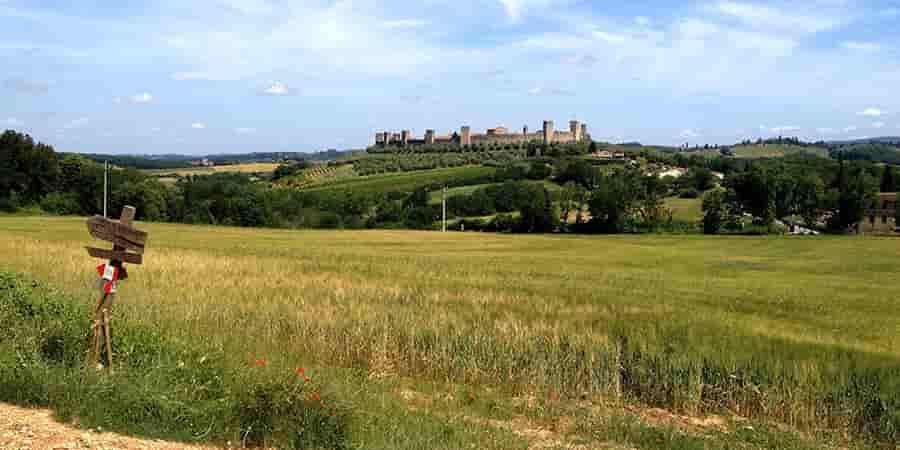
Via Francigena vs Camino de Santiago: which is right for you?
Both are ancient European pilgrimage routes, but the experience is very different — in terms of crowds, infrastructure, landscape, and destination. The Via Francigena attracts around 50,000 pilgrims a year compared to 500,000 on the Camino, meaning more solitude but fewer pilgrim hostels. For a full side-by-side comparison, read our dedicated guide: Via Francigena vs Camino de Santiago.
Expert Advice
Consult our travel specialists for personalised advice on the best time to walk your chosen section of the Via Francigena.
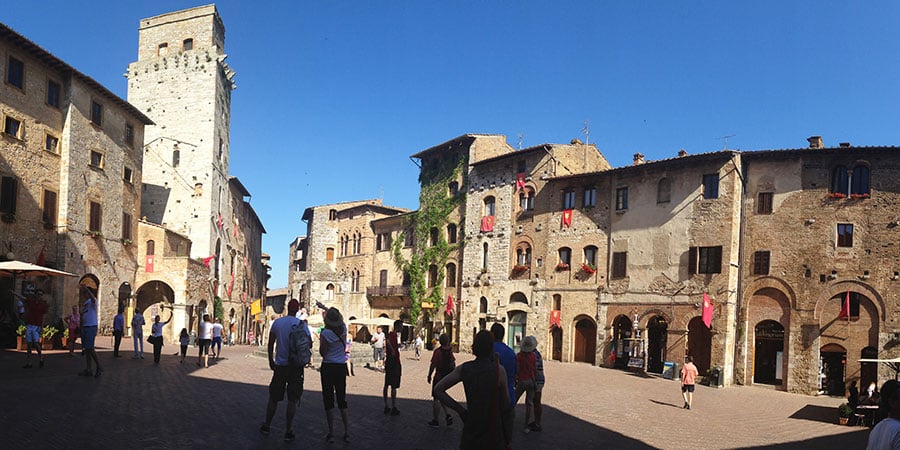
The most popular sections are Tuscany (Lucca to Siena), the last 100km from Viterbo to Rome, and the full route from Lucca to Rome. For those who prefer to walk with an expert local guide, we also offer guided tours along the Via Francigena, departing on selected dates throughout the year.
For more details about our Via Francigena tours or to explore travel agent opportunities, please contact our team.
Via Francigena Frequently Asked Questions
What does Via Francigena mean?
The name translates literally as “the road that comes from the land of the Franks” — the term medieval Italians used for the path arriving from northern Europe. It reflects the route’s origins as the main corridor connecting the Frankish kingdoms of northern Europe with Rome.
Who walked the Via Francigena in history?
The route was documented by Sigeric the Serious, Archbishop of Canterbury, in 990 AD after his pilgrimage to Rome. Before and after Sigeric, the path was used by pilgrims, crusaders, merchants, and royalty throughout the Middle Ages. Charlemagne is among the historical figures associated with the broader network of roads the Via Francigena formed part of.
Is the Via Francigena a UNESCO route?
The Via Francigena is not a UNESCO World Heritage Site, but it holds the title of European Cultural Route, awarded by the Council of Europe in 1994 — the same designation as the Camino de Santiago. Several towns along the Italian section, including Siena and San Gimignano, are individually listed as UNESCO World Heritage Sites.
Is the Via Francigena waymarked?
Yes, particularly the Italian sections, which are well-signed and maintained. Waymarking quality varies on the French and Swiss sections. The official symbol of the route is a white pilgrim on a red background, similar in concept to the yellow arrows of the Camino de Santiago.
What is the difference between the Via Francigena and the Camino to Rome?
They refer to the same route. “Camino to Rome” is the informal English name used to describe the Via Francigena, drawing on the familiar language of the Camino de Santiago. Both terms describe the pilgrimage from Canterbury — or more commonly, from Lucca or another Italian starting point — to Rome.
How many people walk the Via Francigena each year?
Around 50,000 people walk or cycle sections of the Via Francigena annually — still a fraction of the roughly 500,000 pilgrims who completed a Camino de Santiago in 2024. Numbers have been growing steadily, with an increasingly international presence on the route, including pilgrims from outside Europe.
Can I walk the Via Francigena without a guide?
Yes. The Italian sections are well-marked and self-guided walking is very common. Many pilgrims plan independently using stage maps and the pilgrim passport system. For those who prefer support, guided tours are available on selected dates with luggage transfer and accommodation included.
