
Camino Inglés (English Way)
The historic short Camino de Santiago, from the Galician ports of Ferrol or A Coruña to Santiago de Compostela – the route medieval pilgrims from England, Ireland and Northern Europe took after arriving by sea. We book hand-picked accommodation with private bathroom and breakfast, support you on the trail and transport your luggage between stages.
The Camino Inglés in numbers
The Camino Inglés runs 119 km from Ferrol to Santiago de Compostela in 5 stages (about a week) – long enough to earn the Compostela. The Celtic Camino from A Coruña is a shorter 74 km option of 3 walking days.
In 2025, 28,885 pilgrims completed the English Way – around 5% of all Camino walkers – according to the Pilgrim’s Reception Office in Santiago (see our Camino statistics).
Ways to walk the Camino Inglés
In medieval times, pilgrims arrived by sea at the Galician ports of Ferrol and A Coruña and began their walk to Santiago there. Today, these two ports are still the starting points of the Camino Inglés. Choose one of our 2 self-guided routes: every route includes hand-picked accommodation with breakfast and support on the trail, and we transport your luggage between stages.
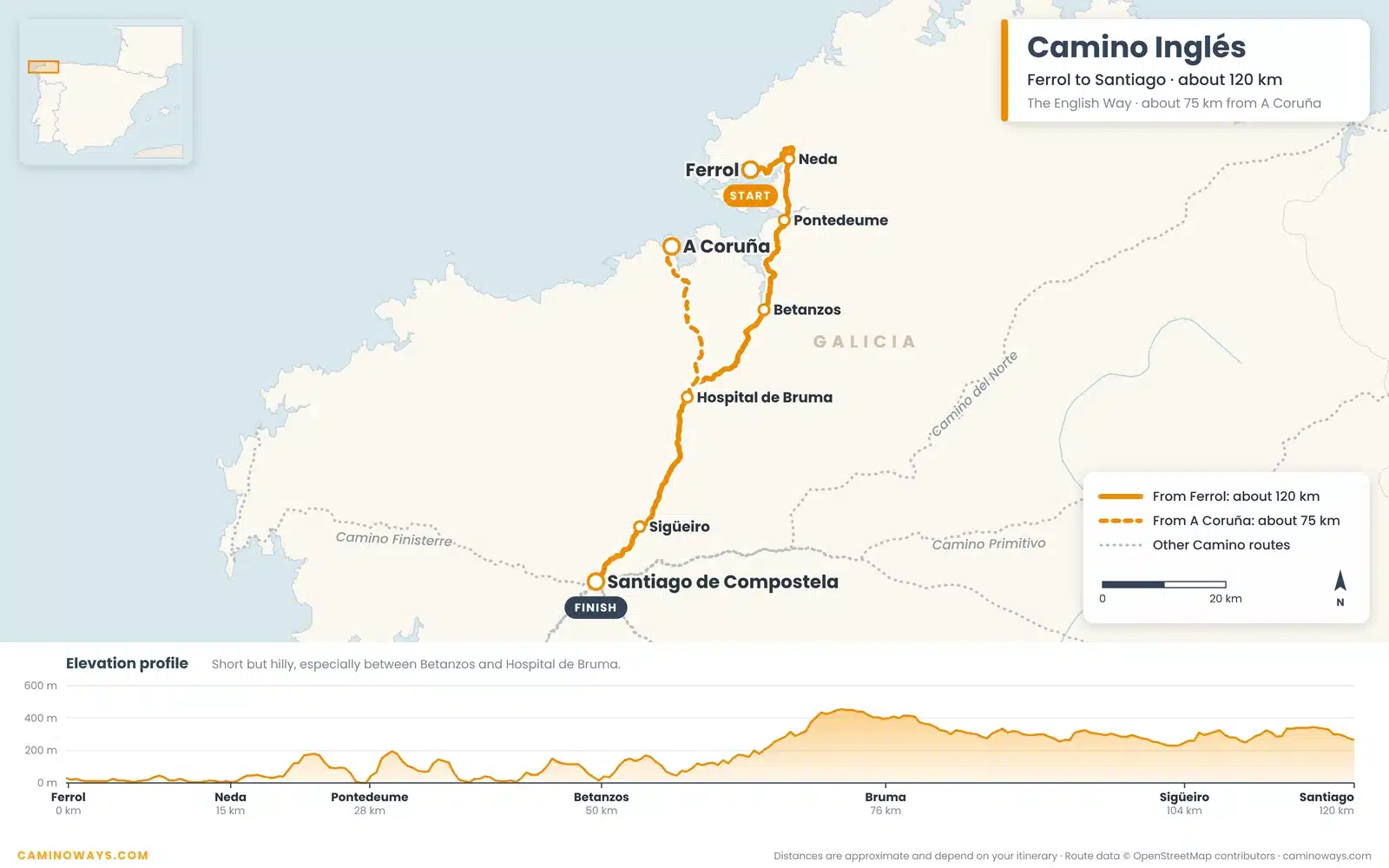

119 km6 nights
The most popular route: five walking days from the port of Ferrol, through Pontedeume and Betanzos, long enough to earn your Compostela.
Start any day · March to November

74 km4 nights
A scenic, shorter alternative for those with less time, or for pilgrims who have already walked the first part of the Celtic Camino in Ireland, Scotland or Wales.
Start any day · April to October
Why walk the Camino Inglés?
The Camino Inglés is perfect if you want a shorter and quieter Camino. It captures all the essentials: woodlands, rolling hills, stone villages, historic towns and the triumphant arrival in Santiago.
Once the preferred path for pilgrims from England, Ireland and Northern Europe, the English Way offers a shorter yet deeply meaningful experience filled with history, warmth and Galician charm. Pilgrims walk through peaceful woodlands, rolling countryside and quaint Galician villages, ending at the magnificent Cathedral of Santiago de Compostela.
With fewer crowds than the Francés or Portugués, it offers a more personal and reflective journey. Along the way, you’ll enjoy Galicia’s legendary hospitality and delicious local cuisine, from fresh seafood to traditional empanadas. For Irish and British pilgrims, the English Way also carries a deep historic connection, following the same route their ancestors once sailed to reach Santiago.
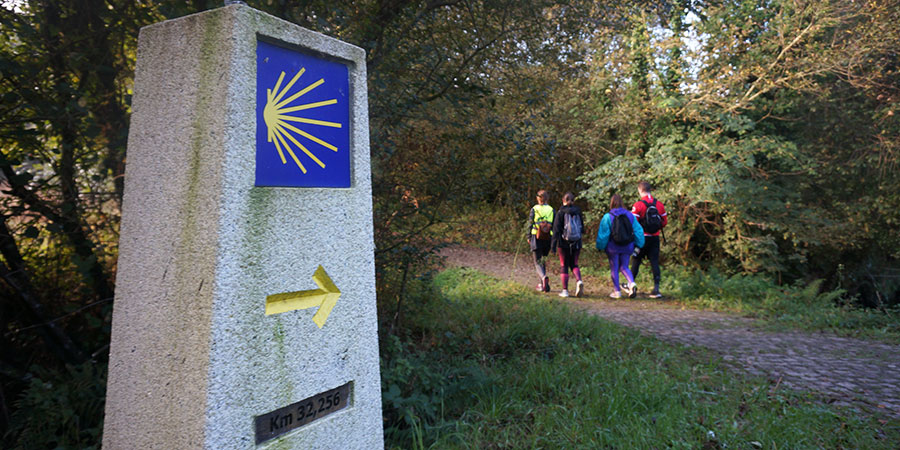
A private room every night
Hand-picked hotels and guesthouses with en-suite bathrooms. No dormitories, no queues for a bed.
Walk light
We transport your luggage between stages, so you carry only what you need for the day.
Your route, your pace
Shorter stages, rest days or a different start town – build it in our Camino Planner.
Support on the trail
Maps, walking notes and a team a phone call away.
Highlights of the Camino Inglés
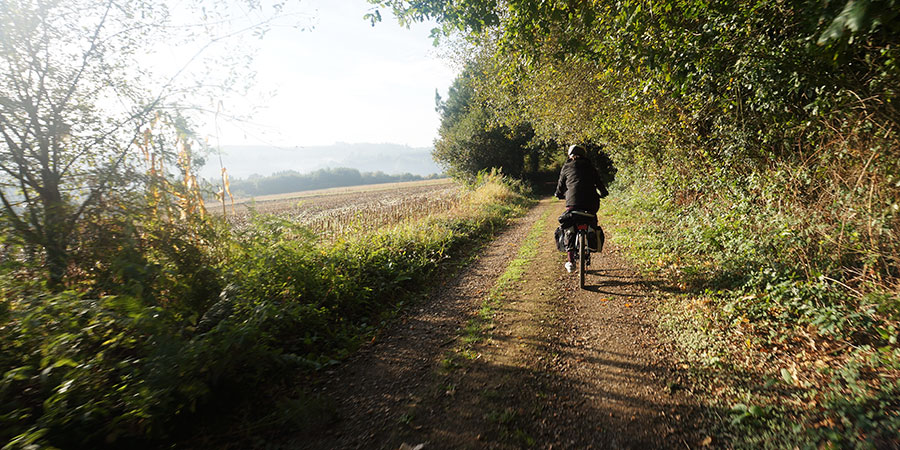
This route feels like a “Camino in miniature”: shorter in length but big on history, atmosphere and reward. Every day brings a mix of coast, countryside and medieval towns, ending with the same emotional arrival at Santiago’s cathedral square.

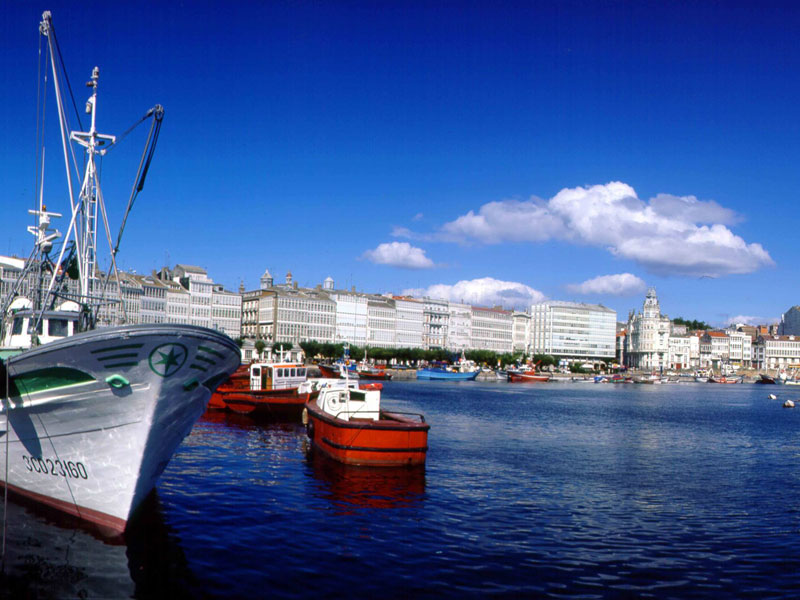
- FerrolHistoric naval city with an impressive Semana Santa Easter festival
- PontedeumeCoastal town with a medieval bridge and beach
- BetanzosCharming old town with Gothic churches and heritage
- Bruma & Mesón do VentoRural hamlets offering peaceful countryside
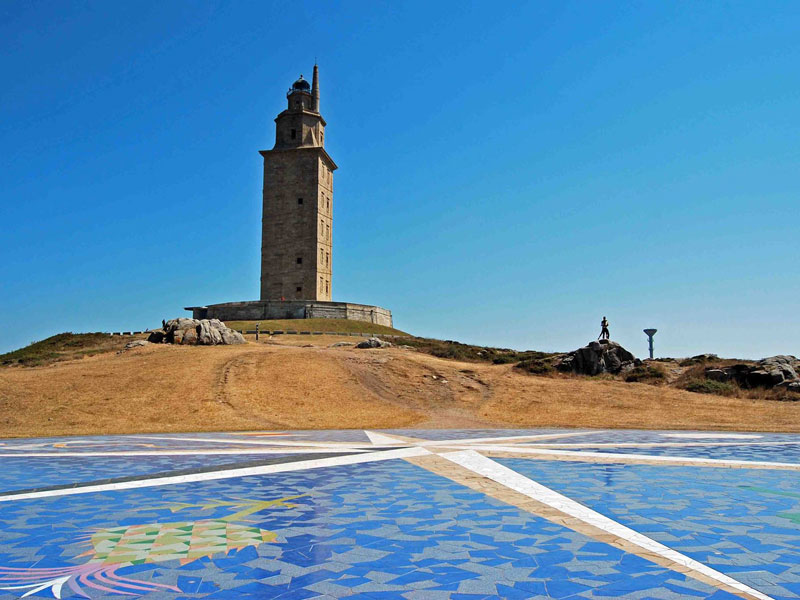
- A CoruñaCeltic Camino start, with the Roman lighthouse (Tower of Hercules)
- Santiago de CompostelaFinishing at the cathedral, as pilgrims have for centuries
2027 is a Holy Year (Xacobeo). Rooms are filling fast, so book early.
Read our Holy Year guideThe Camino Inglés, stage by stage
The Camino Inglés runs 119 km from Ferrol to Santiago de Compostela in 5 stages. The Celtic Camino from A Coruña joins it in Bruma after one long first day. Open each route to see every town, the distance from the previous one and how far it is to Santiago.
Ferrol to Santiago
The first two walking days of the Camino Inglés from Ferrol are beautiful. You weave along the coast, soaking in the seaside views, and the towns along the way are quaint and pretty, with Pontedeume and Betanzos being particular highlights. You can pause between towns to rest or enjoy a refreshing swim at A Magdalena beach. Betanzos is rich in history, and exploring its beautiful old buildings is one of the town’s great joys. Bruma, Mesón do Vento and Sigüeiro are your last stops before arriving in Santiago de Compostela; the green countryside around Ordes near the Church of San Xiao offers a final, peaceful rural moment on your Camino.
| Town | From previous | To Santiago | Est. walking time |
|---|---|---|---|
| Ferrol | – | 119 km | – |
| Pontedeume | 29 km | 90 km | 7 h 45 min |
| Betanzos | 21 km | 69 km | 6 h 15 min |
| Bruma (Mesón do Vento) Hard stage | 28 km | 41 km | 8 h 15 min |
| Sigüeiro | 24 km | 17 km | 6 h 15 min |
| Santiago de Compostela | 17 km | – | 4 h 45 min |
A Coruña to Santiago (Celtic Camino)
The English Celtic Camino is gaining popularity among walkers from all over the world. In ancient times, pilgrims from the UK and Ireland would have arrived by boat to the port of A Coruña to continue their Camino journey. Starting 74 km from Santiago, the route leaves A Coruña along the bay before cutting inland and joining the Camino Inglés from Ferrol in Bruma. The cathedral in Santiago has allowed special provisions for pilgrims who walk routes such as the Kerry Camino in Ireland before they arrive in Spain, so they can claim their Compostela.
| Town | From previous | To Santiago | Est. walking time |
|---|---|---|---|
| A Coruña | – | 74 km | – |
| Bruma (Mesón do Vento) Hard stage | 33 km | 41 km | 9 h 15 min |
| Sigüeiro | 24 km | 17 km | 6 h 15 min |
| Santiago de Compostela | 17 km | – | 4 h 45 min |
Walking times are estimates, based on an average pace of about 4 km/h without breaks, with extra time added for the steeper climbs, such as the climb to Bruma. Your own pace, rest stops and the terrain will change them.
Planning your Camino Inglés
The best time to walk the Camino Inglés is spring or autumn, the route is moderate with steady climbs before Bruma, and you only need a light pack because we transport your luggage between stages.
How to earn your Compostela
Walk the full Camino Inglés from Ferrol (119 km) and collect stamps in your Pilgrim Passport along the way: at the Pilgrim’s Office in Santiago you will receive the Compostela. The 74 km route from A Coruña does not meet the 100 km requirement on its own, unless you have already completed a Celtic Camino in Ireland, Scotland or Wales. Cycling is possible, but neither route meets the 200 km required for cyclists. Learn more in our guide to Compostela certificates.
When to walk the Camino Inglés
The best months are March to November, especially spring and autumn. Summer is mild (around 25°C / 77°F on average), not as hot as inland Spain. Winter is walkable, but cooler and wetter.
Terrain and difficulty
The Camino Inglés is a moderate walk: a mixture of coastal and inland countryside, with daily ascents and descents of around 300 m. The first coastal days and the climb to Bruma are the most challenging; the last stages into Santiago are easier.
What to bring on the Camino Inglés
Pack as light as you can: broken-in walking shoes or boots, a waterproof jacket (rain is common in Galicia), quick-dry layers, sun protection and a refillable water bottle. With luggage transfers, you only carry a daypack. Our Camino packing guide ebook is free to download and will help you decide what to bring.
History of the Camino Inglés
The Camino Inglés dates back to the 12th century, when pilgrims from England, Ireland and Scandinavia arrived by ship in Galicia. In 1147, English Crusaders landed in Ferrol and A Coruña on their way to the Holy Land, helping Portugal’s first king capture Lisbon. The Icelandic monk Nicholas Bergson recorded maritime pilgrim routes from Iceland through Europe, and British pilgrims left gifts such as the alabaster altarpiece (1456) and the famous “Pearl Cross”, donated by James IV of Scotland. Orders like Sancti Spiritus and the Franciscans built pilgrim hospitals in Ferrol, Betanzos and Bruma. These records make the Camino Inglés one of the most international pilgrim routes, linking Northern Europe with Santiago.
How we help you on the Camino
Handpicked hotels
Handpicked hotels, with breakfast included every morning.
Luggage transfers
Luggage transfers let you walk light.
24/7 support
24/7 support available while you walk.
Maps & walking notes
Maps & walking notes provided for every stage.
Prefer to walk with a group and a guide? See our Guided Camino Tours, or browse all Self-Guided Camino Tours. Find out more about our Camino travel services.
What our pilgrims say

“Camino Ways made the trip so easy. The places we stayed were amazing and having our luggage transported allowed us to just get up and go. Would highly recommend using Camino Ways.”
Joy Shelby, United States
Trustpilot
“Transfers were flawless. Accommodations top notch. Trip of a lifetime.”
Robert Phillips, United States
Trustpilot
“Everything sorted for you. Great communication and efficient service all around.”
Kate Mugridge, United Kingdom
Trustpilot
Tailor-make your Camino
Choose your starting point, dates, pace and type of accommodation. We book your stays, transport your luggage between stages and look after you all the way to Santiago.
- Hand-picked accommodation with private bathroom and breakfast
- We transport your luggage
- Support throughout your trip
The Camino Inglés is the short Camino with a big soul. Perfect for those with limited time, it offers history, scenery and the authentic pilgrim spirit in just a few days. Whether you walk from Ferrol for your Compostela or from A Coruña on the Celtic route, you’ll arrive in Santiago with a true Camino experience. For a personalized Camino Inglés itinerary, use our award-winning planner.
Your questions about the Camino Inglés
Straight answers to what pilgrims ask us most before they book.
How many days do I need to walk the Camino Inglés?
The Camino Inglés from Ferrol covers 119 km in 5 walking days; with your first night in Ferrol, our trip lasts 7 days and 6 nights. The Celtic Camino from A Coruña covers 74 km in 3 walking days (4 nights).
What is the Camino Inglés and why is it called the "English Way"?
The Camino Inglés, or English Way, is the Camino de Santiago route historically taken by pilgrims from England, Ireland, Scotland, Wales and Scandinavia. From the 12th century onwards, these northern European pilgrims arrived by ship to the Galician ports of Ferrol and A Coruña, then walked inland to Santiago de Compostela. Today, it remains one of the most historically significant Camino routes and is increasingly popular with British and Irish pilgrims retracing their ancestors’ journey.
What is the difference between the Camino Inglés from Ferrol and from A Coruña?
Both routes start on the Galician coast and merge in Bruma Mesón do Vento before reaching Santiago. The key difference is distance and certificate eligibility. The Camino Inglés from Ferrol is 119 km over 5 walking days and qualifies for the Compostela certificate. The Camino Inglés from A Coruña (also called the Celtic Camino) is 74 km over 3 walking days and does not qualify for the Compostela on its own – unless combined with a recognized Celtic Camino route in Ireland, Scotland or Wales.
Do I get the Compostela on the Camino Inglés?
Yes, if you start in Ferrol: the 119 km route is more than the 100 km you need to walk. From A Coruña (74 km), you only get the Compostela if you have also completed a Celtic Camino in Ireland, Scotland or Wales. Cyclists need 200 km, so neither route qualifies by bike. Read more about Compostela certificates.
What is the Celtic Camino and how does it work?
The Celtic Camino is a special arrangement that allows pilgrims to combine a short pilgrimage in Ireland, Scotland or Wales with the 74 km Camino Inglés from A Coruña, qualifying for the Compostela certificate. The most popular option is the Kerry Camino in Ireland, but routes in Scotland and Wales also count. The Cathedral of Santiago officially recognizes this combination, honoring the historic seafaring tradition of northern European pilgrims who originally landed in A Coruña.
Why is the Camino Inglés good for pilgrims with limited time?
The Camino Inglés is the shortest of the official Compostela-qualifying Camino routes that can be completed start-to-finish in a single trip. From Ferrol, you walk 119 km in 5 days and earn the Compostela. From A Coruña, the Celtic Camino takes just 3 walking days. This makes it ideal for pilgrims with one week of holiday or those who can’t commit to the longer Francés or Portugués routes – without sacrificing the authentic Camino experience.
How does the Camino Inglés compare to the last 100 km of the Camino Francés from Sarria?
Both routes are around 100–120 km and can be walked in about a week, but the experience is very different. Sarria is much busier, especially in summer, with a strong social atmosphere and crowds of pilgrims. The Camino Inglés is significantly quieter, more reflective, and combines coastal scenery (Ferrol, Pontedeume, Betanzos) with rural Galician countryside. Choose Sarria for camaraderie and tradition; choose the Inglés for solitude and a quieter Galician experience.
What are the must-see highlights on the Camino Inglés from Ferrol?
Key highlights include the historic naval city of Ferrol (especially during its famous Easter Semana Santa festival), the medieval town of Pontedeume with its impressive 14th-century bridge, and Betanzos with its Gothic churches and well-preserved old town. The rural hamlets of Bruma and Mesón do Vento offer peaceful countryside, and you finish at the magnificent Cathedral of Santiago de Compostela. A swim at A Magdalena beach is a popular pause along the coastal section.
How do I get to Ferrol or A Coruña to start the Camino Inglés?
Both starting points are easy to reach. A Coruña has its own airport (LCG) with direct flights from London, Dublin and other European cities, plus a major train station with connections from Madrid and Barcelona. Ferrol is a 1-hour train or bus ride from A Coruña. Many pilgrims fly into A Coruña and then continue to Ferrol for the longer route. Santiago de Compostela airport (SCQ) is also a convenient option, located about 1.5 hours by bus or train from both starting points.
Is the Camino Inglés a good first Camino?
Yes – especially for pilgrims who want a true Camino experience without the crowds. It’s manageable in length, well-marked, has good accommodation, qualifies for the Compostela (from Ferrol), and offers diverse landscapes from coast to countryside. It’s particularly popular with first-time pilgrims from the UK and Ireland for its historic connection, but suits anyone wanting a shorter, quieter introduction to the Camino de Santiago.
Can I cycle the Camino Inglés?
Cycling is possible on the Camino Inglés, but neither the Ferrol (119 km) nor the A Coruña (74 km) route meets the 200 km minimum required for cyclists to earn the Compostela certificate. Cyclists wanting the certificate via this route would need to combine it with another section, such as starting further inland or adding additional cycling kilometers in Galicia.
Last updated: November 2026 · Written by Marta Ponte, CaminoWays
Other Camino routes
Camino Francés · Camino Portugués · Camino Primitivo · Camino del Norte · Camino Finisterre · Camino de Invierno · Via de la Plata · Chemin du Puy · Via Francigena · Rota Vicentina
See all Camino de Santiago routes, or start with our guide to the Camino de Santiago.