
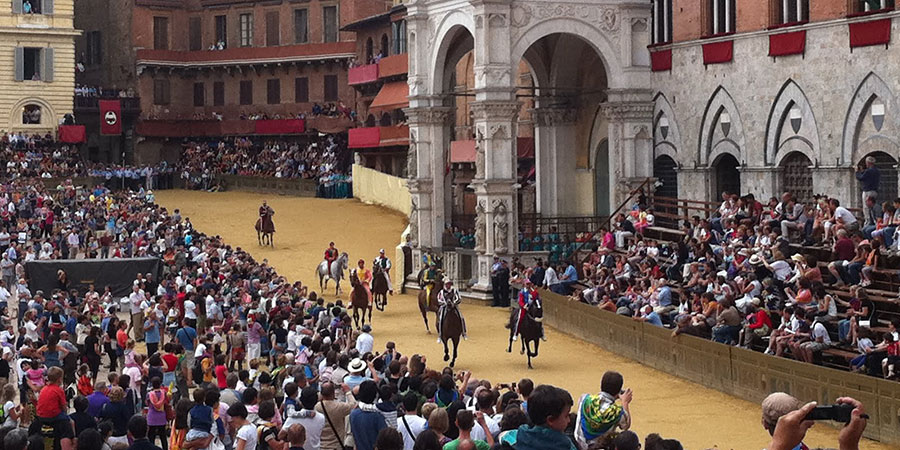
Planning a walking holiday in Tuscany on the Via Francigena? If you are travelling in July or August, you will have a chance to discover one of the oldest and most spectacular events of the year in Tuscany: the Siena Palio or Palio di Siena. Feel the strong tradition from the crowd, supporting their horse rider to bring honor and pride to their family.
The Palio di Siena is not a tourist spectacle. It is a living piece of medieval civic culture that has been running almost uninterrupted since at least 1644, and for the 40,000 Sienese who crowd into the Piazza del Campo on race day, it is the most important event of the year. For pilgrims passing through Siena on the way to Rome, stumbling into it — or planning around it — is one of the great Via Francigena experiences.
Lee Marshal from The Telegraph writes a great guide to this fantastic event.
Table of contents
What is the Siena Palio?
It’s perhaps Italy’s most famous annual sporting event. But Siena’s Palio is as much about pageantry, civic identity and Sienese pride as it is about a bareback horse race that lasts, on average, just seventy-five seconds.
Held in honour of the Virgin Mary, the race takes place twice a year. Ten of the city’s seventeen contrade, or districts, are represented by a horse and jockey in each race. The seven districts that didn’t race in the previous July or August contest compete by right, and are joined by horses from three lucky ‘repeat’ contrade, drawn by lot.

The race is no tourist-board invention, like some of Italy’s supposedly “Medieval” fairs, jousts and pageants: it has been held almost uninterruptedly in Siena’s civic hub, Piazza del Campo, since 1644 at least. And it’s certainly not staged for the benefit of visitors. In fact, the 40,000 Sienese who crowd into the Campo on race day (two-thirds of the city’s population) are largely oblivious to their 20,000 Italian and international guests. To gauge the strength of contrada loyalties, bear in mind that it is still common for ‘mixed-marriage’ couples to separate for the days leading up to and including the race if the contrada of the husband and wife both have a horse in contention.
When is the Siena Palio?
The Palio is helo twice a year on July 2 and August 16. To absorb the charged atmosphere, it’s worth coming to Siena at least four days before the race itself. By this time, Piazza del Campo will already have been turned into a race-track, with workmen covering the course around the outside of the scallop-shaped piazza in yellow earth and staking out the central area which is the only free vantage point.
In the days leading up to the Palio, you can witness la tratta (the selection of the horses, around midday on June 29 and August 13), and the six horse trials that take place from the evening of la tratta day to the morning of Palio day. To watch these, make sure you’re in the cordoned-off area in the centre of the square by 8.40am for morning trials and 7.15pm for evening trials.
The other great Palio tradition are the festive open-air dinners each contrada holds on the evening before the race – on July 1 and August 15 – with trestle tables running the length of the district’s main street or filling up the main piazza. There are various Siena insiders who can get you into one of these (see below for a couple of recommendations), but an alternative is just to turn up a day or so before at the HQ of your chosen contrada and ask (addresses can be found at ilpalio.org). Typically, a dinner ticket costs around €50 a head.
To the despair of photographers, the race itself takes place just as the day’s light is fading, after a seemingly endless melée in which horses and riders jockey for position behind the canapa, or starter’s rope. It’s preceded by a two-hour-long procession in historical costume which evokes the glory days of the Sienese Republic in the thirteenth and fourteenth centuries, when it was the centre of the Italian banking system and had the same population as Paris.
The Days Before the Race
The Palio is not a single day — it unfolds over four days of mounting ceremony, preparation, and tension.
- La tratta — horse selection takes place around midday on 29 June (for the July Palio) and 13 August (for the August race). Ten horses are chosen from a larger pool, assigned by lot to the competing contrade. This is the moment when the mood of the city changes: every contrada immediately begins assessing their horse’s chances, negotiating with jockeys, and planning strategy.
- Six horse trials follow on the evenings and mornings between la tratta and race day. These are worth attending for atmosphere alone — the square fills with crowds, the horses run in the actual race configuration, and the tension between contrade is already palpable. Trials take place at 8.40am (arrive early to secure space in the central standing area) and 7.15pm each day.
- The pre-race dinners on the evening before the race — 1 July and 15 August — are one of the most memorable things you can experience in Siena. Each contrada holds a long open-air dinner for its members and guests, with trestle tables running the length of the district’s main street or filling the neighbourhood’s main square. These are not ticketed tourist events — they are genuinely communal celebrations. Ask at your accommodation about attending; many guesthouses can help you get a place at a contrada dinner.
- The historical pageant on race day itself — the Corteo Storico — precedes the race with a procession of hundreds of participants in medieval costume, carrying the contrade’s banners. The flag-throwing display, or Sbandierata, draws applause even from the most jaded observer.
How to visit the Palio?
There are three ways to see the race:
- Standing in the centre of the Piazza (free) The large central area of the Campo is free and open to the public. It is, however, extremely crowded — you may be standing shoulder to shoulder for several hours before the race begins, in summer heat, with no shade. If you want to be in the thick of it and feel the atmosphere at its most intense, this is the place. Arrive very early — by late morning at the latest — and be prepared to stay put.
Be aware that there are no toilet facilities in this central section, though there are soft-drink sellers and first-aid posts. Bring plenty of water, and make sure you have hats and sun-block. Raincoats are optional; if it rains with any intensity in the hour or so before the Palio itself, the race will in any case be postponed until the following day. Given the wait, the lack of seating and pìpì-pavilions, and the crush as the square fills up, this is not a place for young kids. - Seats in the stands (palchi) — €160 to €350. The second possibility is to book a seat on one of the stands or palchi around the square; those closest to the mossa (the starting and finishing line) cost the most. Nothing about the Palio is straightforward, so it should come as no surprise that you can’t just turn up at the tourist office and buy a ticket. Palchi are owned and run by the bars, restaurants or shops they stand in front of – so try asking if you happen to be in Siena months before the event, or better still ask this year for next. Prices are in theory agreed with the town council, and range from around €160 to €350 per seat.
- Balconies and windows of the surrounding palazzos — €350 and up The buildings overlooking the Campo have windows and balconies with extraordinary views. These are privately owned — often by Sienese families who have held them for generations — and can command very high prices. Access is informal and requires connections or significant planning in advance.
Whatever your vantage point, make sure you choose a contrada to root for – it makes the whole experience so much more fun. Once you’ve found one, and bought the appropriate scarf – readily available from souvenir stalls and shops – you’ll want to catch the priestly blessing of the horse and jockey in the official contrada church early in the afternoon of the Palio day (if the horse leaves a steaming visiting card on the church floor, it’s considered to be a good omen). And if your contrada wins, you can try crashing the victory dinner that evening. Your adoptive contradaioli are likely to be too happy, and too drunk, to resent the invasion.
Planning Your Visit
- Book accommodation early — very early. Siena fills completely for both Palio dates. If you’re walking the Lucca to Siena section in late June or early August, plan your arrival date in Siena carefully and book as far ahead as possible. Consider staying in a village on the outskirts and travelling in by bus or taxi on race day if central accommodation is unavailable.
- Give yourself at least four days in Siena if the Palio is the reason you’re there. The atmosphere builds across the days leading up to the race, and arriving on race day without any of the context — the trials, the contrada dinners, the pageantry — means missing most of what makes it special.
- The race itself can be delayed or disrupted by a false start (a not-infrequent occurrence), which means the schedule is unpredictable. Keep your plans flexible on race day.
*This article has been originally published by: https://www.telegraph.co.uk/travel/destinations/europe/italy/articles/siena-palio-how-to-see-the-race/
The Palio and the Via Francigena
Siena sits on Section 14 of the Via Francigena — the Lucca to Siena walk — and is a UNESCO World Heritage Site. For pilgrims walking this section, Siena is the natural endpoint of a week’s walking through Tuscany. Arriving on foot into the city, and then finding yourself in the middle of the Palio’s preparations, is exactly the kind of collision of history and experience that makes the Via Francigena different from any other route.
For all walking and cycling routes that finish in Siena, see our Via Francigena in Tuscany itineraries, or use the Camino Planner to plan your dates around the race.

FAQ: Palio di Siena
When does the Palio di Siena take place?
Twice a year: 2 July (in honour of the Madonna of Provenzano) and 16 August (in honour of the Assumption). The race itself lasts around 75 seconds but the event spans four days of trials, ceremonies, and celebrations.
How much does it cost to watch the Palio?
Standing in the centre of the Piazza del Campo is free. Seats in the stands (palchi) range from around €160 to €350. Balcony views from surrounding buildings can cost €350 and upwards.
How do I get tickets for the Palio di Siena?
There is no central ticketing system. Palchi are managed by the bars, shops, and restaurants in front of which they stand — ask in Siena months before the event, or plan ahead for the following year. The central standing area is free but very crowded.
How far in advance should I book accommodation in Siena for the Palio?
As early as possible — ideally six months to a year ahead for central Siena. Alternatively, consider staying in a nearby village and travelling in on race day.
Is the Palio suitable for children?
The central standing area can be overwhelming for young children due to heat, crowds, and hours of waiting. Seated palchi are a more manageable option for families.
How does the Palio connect to the Via Francigena?
Siena is the endpoint of the Lucca to Siena section of the Via Francigena. Pilgrims walking in late June or early August can time their arrival to coincide with the race preparations or race day itself.
