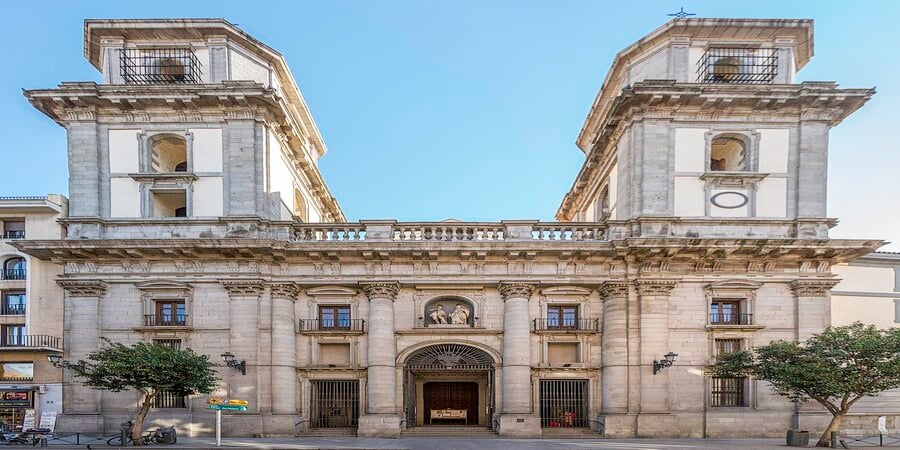
Hotel Real Colegiata San Isidoro: sleeping inside an 11th-century monastery
The Real Colegiata de San Isidoro in León is one of the great Romanesque buildings of Spain — a basilica, a royal pantheon holding eleven kings, a cloister, a library and a museum, all in one complex in the middle of the city. Since 2005 part of it has also been a 30-room hotel. It stands directly on the Camino Francés, just over 300km from Santiago de Compostela, which makes it one of the few places on the route where you can sleep inside the monument you came to see.
What it means to stay here
Most pilgrims walking through León visit San Isidoro, spend forty minutes in the pantheon and move on. Staying here means the building empties in the evening and you are still in it.
The hotel occupies part of the monastic complex and calls itself a Casa de Espiritualidad — a house of spirituality. In practice that means quiet: thick walls, cloisters you can walk at dusk, and thirty rooms rather than three hundred. The modern comforts are there, fitted in plainly and without pretending the building is anything other than what it is.
The building you’ll be sleeping in
In 1063, King Fernando I and Queen Sancha had the basilica consecrated and the remains of Saint Isidore of Seville brought north to León. Isidore had been Archbishop of Seville from around the year 600 until his death in 636, and was the most learned man in Visigothic Spain — his Etymologiae was still being copied across Europe five centuries later.
The complex that grew around his tomb is Romanesque, built and extended through the 11th and 12th centuries. It is not a UNESCO site in its own right, but it is part of the UNESCO-listed Camino Francés, which passes its door.
The Royal Pantheon
This is what people come for, and it is not where most first-time visitors expect.
The Panteón de los Reyes sits at the foot of the basilica, in the portico at the western end — you walk through it on the way in, not out. It is a low, square room of about eight metres a side, divided into three naves by seven arches, with capitals carved in the 11th century.
The ceilings are the reason it is sometimes called the Sistine Chapel of Romanesque art: the vaults are covered in painted scenes that have never been repainted, only cleaned.
Eleven kings of León are buried here — among them Alfonso IV, Ramiro II, Ordoño III, Sancho I, Ramiro III, Bermudo II, Alfonso V, Bermudo III, Fernando I and García of Galicia — alongside queens including Sancha of León and Urraca I, the first woman to reign over León in her own right. Infantes, bishops and abbots fill the rest.
The cloister, the library and the museum
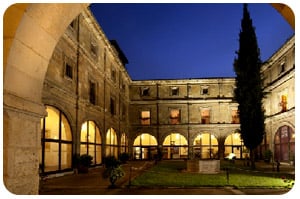
The cloister is a covered walkway around a courtyard garden, built for contemplation and study by the monks who lived here. It is open to guests and to the public.
The museum holds Romanesque and Gothic works, reliquaries and illuminated manuscripts from the monastery’s own library — one of the oldest surviving collections of its kind in Spain.
And the restaurant serves León cuisine: cecina, morcilla, botillo from El Bierzo further west. If you have been walking, this is not the night to eat lightly. Our guide to food on the Camino Francés has more.
It is also one of the most popular places to start a Camino — just over 300km from Santiago, walkable in around two weeks. See how it compares in our guide to the best starting points on the Camino Francés, or trace the route on our Camino Francés map.
Staying here on your Camino
We can include the Real Colegiata San Isidoro on any itinerary that passes through or begins in León. All CaminoWays holidays come with accommodation booked ahead, luggage transfer between stages and a holiday pack with maps and notes.
Use our Camino Planner to build your route and see the price instantly, or get in touch and we’ll put an itinerary together for you.
Maria is from Viveiro, in the misty and beautiful northern coast of Galicia, and now calls Ireland her adopted home. She adores Santiago, where she studied Journalism at Santiago de Compostela University. She also loves travel, food, books, and arty and crafty. She has walked and cycled many trails including many Camino routes, Japan's Kumano Kodo, the Kerry Camino in Ireland and many others.