
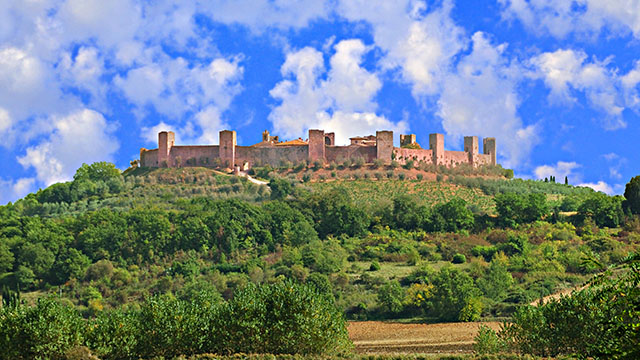
Tuscany is world-renowned as being one of the most beautiful parts of Italy. The Via Francigena route, which passes through Tuscany, offers the perfect opportunity to experience the region by bike. Along the way, you will be immersed in a region of tranquillity and outstanding beauty, with the bonus of offering some of the world’s most incredible food and wine. So, why cycle the Via Francigena in Tuscany?
For a personal account of what it’s actually like, read our amateur cyclist in Tuscany story. For practical information on bikes and logistics, see our cycling how it works guide.
Table of contents
Is This Route Right for You?
Due to its relative gentleness, excellent condition of the route, and relatively traffic-free nature, this part of the Via Francigena is ideal for families and inexperienced cyclists. If you feel that our cycling itinerary may be too demanding for you, why not try our walking itinerary instead? This will allow you to experience and enjoy the beauty and tranquility of Tuscany without the effort becoming too much.
1. The Iconic White Gravel Roads of Tuscany
For any cycle racing fans, much of the route may be familiar. The white gravel roads over which the Via Francigena passes constitute a significant feature of the Strade Bianche cycle race, which takes place every March. It’s hard to picture Tuscany without thinking of these roads rolling over low hills between wheat fields, vineyards, olive groves and the Poplar trees, which are synonymous with the region. These roads are as much a part of the landscape as they are a product of functionality. By cycling through Tuscany, you will become part of the landscape as you take in the region’s sights, sounds, and smells and feel the breeze on your face.
2. The Towns Along the Way
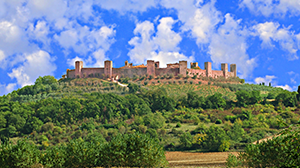
Most of the Via Francigena in Tuscany follows gravel roads, but some sections of single-track roads through woods and farms exist. These gravel roads have shallow volumes of traffic. Along the way, you will pass farmhouses and churches and pass through the stunning towns of San Gimignano, San Miniato, Monteriggioni and Siena. San Gimignano is a UNESCO World Heritage site and could be viewed as a medieval metropolis due to its many towers. Monteregionni is a work of architectural beauty that sits atop a small hill that can be seen for miles. Siena has to be one of the most beautiful towns in Italy. It is crammed with incredible architecture that surrounds the Piazza del Campo. The Piazza is where the famous Palio horse race occurs twice a year. It’s also a great place to sit with a coffee or a glass of wine and watch the world go by as you recover from your day cycle.
3. The Terrain
The route has flat sections but has many ups and downs. While there are some relatively steep climbs, they are generally quite short, and you will be rewarded with stunning views and beautiful medieval hilltop towns and villages. When descending steep rocky paths and gravel tracks, it’s best to sit back in the saddle so your bike isn’t front-heavy. You should also gently use both brakes together.
It is probably best to have some cycling experience but it is not essential. You should bring a waterproof jacket, sunglasses and padded cycling shorts, making the journey easier. If you don’t fancy wearing lycra, many types of casual shorts are now available with padding for cycling. You should also bring a puncture repair kit and/or spare tubes and tyre levers. In Italy, helmets are not required by law, but we always advise people to wear them. A mini-tool kit with Allen keys and some spanners is always a valuable thing to have when cycling. It is essential to be able to fix a puncture or other minor problems with your bike, as there will be points where you may not be near a bike shop. Having said that, most towns are well supplied with bike shops if you need to have something fixed or if you need to buy something.
4. The Food
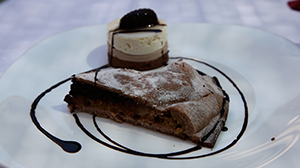
From a food point of view, Tuscany is a cyclist’s dream. Plenty of delicious pasta, risotto, pizza, fresh fruit and vegetables will keep you fueled. Italy is also an excellent location for vegetarians, as a significant emphasis is placed on tasty meat-free dishes. The region is, of course, famous for its Chianti wine, which makes a beautiful accompaniment to a bowl of hearty Tuscan bean stew. San Miniato is world-renowned for its Black Truffles, and the extra virgin olive oil of the area is so good that when combined with fresh bread, it could be a meal in itself. You will see many world-class ice creams along the way, so why not treat yourself after a day in the saddle? And don’t forget, if you need a pick-up, Tuscany has some of the best coffee in the world.
For the full guide to what to eat and drink in the evening, read our perfect Italian dinner in Tuscany.
5. The Pace
Cycling the Via Francigena in Tuscany covers more ground than walking — but at a pace that still lets you absorb the landscape, stop in villages, and arrive with energy to explore. Daily distances average 20–45 km, which gives you time to cycle, rest, eat well, and do it all again the next day. It is a genuinely relaxed way to travel through one of Europe’s great landscapes.
Ready to cycle the Via Francigena? Find out how your cycling trip works — bikes, kit, and support included — or go straight to our Cycling Via Francigena from Lucca to Rome itinerary.
See our cycling the Via Francigena from Lucca to Rome itinerary or use our Camino Planner to plan your trip.
FAQ: Cycling the Via Francigena in Tuscany
Do I need to be an experienced cyclist to cycle the Via Francigena in Tuscany?
Not necessarily. The Tuscany section is one of the most accessible long-distance cycling routes in Italy. Some cycling experience is useful, particularly for the gravel descents, but the route is regularly completed by first-time long-distance cyclists. Read our amateur cyclist in Tuscany account for a first-hand perspective.
How far do you cycle each day on the Via Francigena in Tuscany?
Daily distances average between 20 and 45 km depending on the stage. The itinerary is designed to be manageable — you arrive in each town with time and energy to explore, eat well, and rest before the next day.
What type of bike do I need?
The route is predominantly on gravel roads, so a hybrid or gravel bike is ideal. Road bikes can be used but may struggle on the rougher sections. CaminoWays can arrange bike rental for the Tuscany section.
Is the Via Francigena in Tuscany suitable for families?
Yes — it is one of the most family-friendly cycling routes in Italy. The terrain is relatively gentle, traffic is minimal on the gravel roads and the daily distances can be adapted to suit younger or less experienced riders.
When is the best time to cycle the Via Francigena in Tuscany?
Spring and autumn are ideal, comfortable temperatures, fewer tourists and the landscape at its most photogenic. Autumn adds the grape and truffle harvests. Summer is possible but July and August can be very hot.
How do I book a cycling trip on the Via Francigena in Tuscany?
See our cycling the Via Francigena from Lucca to Rome itinerary or use our Camino Planner to build a custom itinerary.
