
Camino Portugues Variante Espiritual
The Camino Portugués Variante Espiritual, also known as the Traslatio, is the most distinctive branch of the Portuguese Way. Shaped by legend, water, and quiet landscapes, it offers a slower, more reflective approach to Santiago than the Coastal or Central routes.
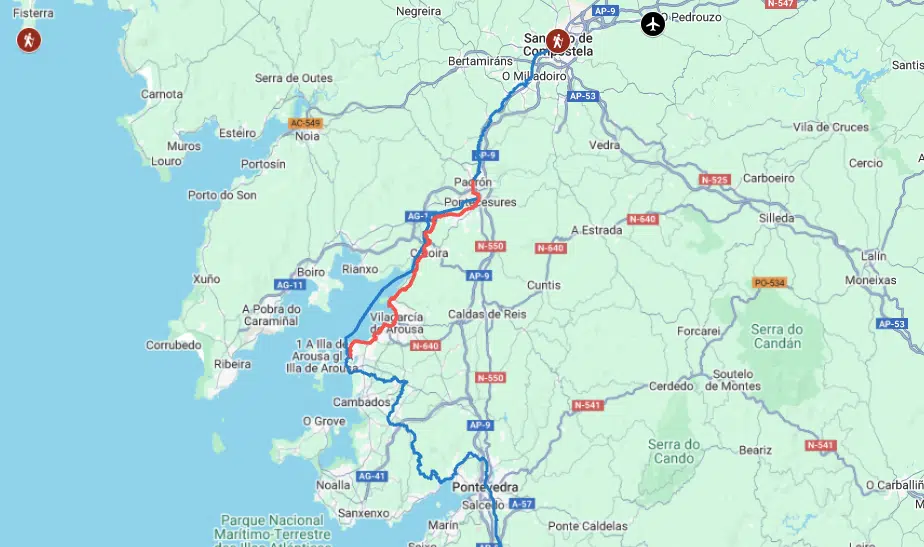
Rather than starting as a separate Camino, the Variante Espiritual branches off the main Portuguese route just after Pontevedra. It leads pilgrims through coastal scenery, fishing villages, vineyards, and ancient monasteries, including Armenteira, before following the peaceful Ruta da Pedra e da Auga along the Armenteira River — one of Galicia’s most scenic walks.
The uniqueness of the Traslatio boat journey
What makes the Variante Espiritual truly unique is its symbolic boat journey across the Ría de Arousa (Arousa’s estuary). This crossing retraces the legendary voyage of Saint James’s remains, said to have travelled by sea and river to Iria Flavia, near present-day Padrón.
From Vilanova de Arousa, pilgrims take this recognised Camino stage by boat, replacing a road-heavy section with a calm water journey. After arriving near Padrón, the route rejoins the main Camino Portugués for the final walk to Santiago. By combining land, legend, and sea, the Variante Espiritual offers a deeply meaningful and memorable pilgrimage experience.
Why Walk the Variante Espiritual?
- Retrace the Apostle James’s final journey by sea — a path guided by angels and a star.
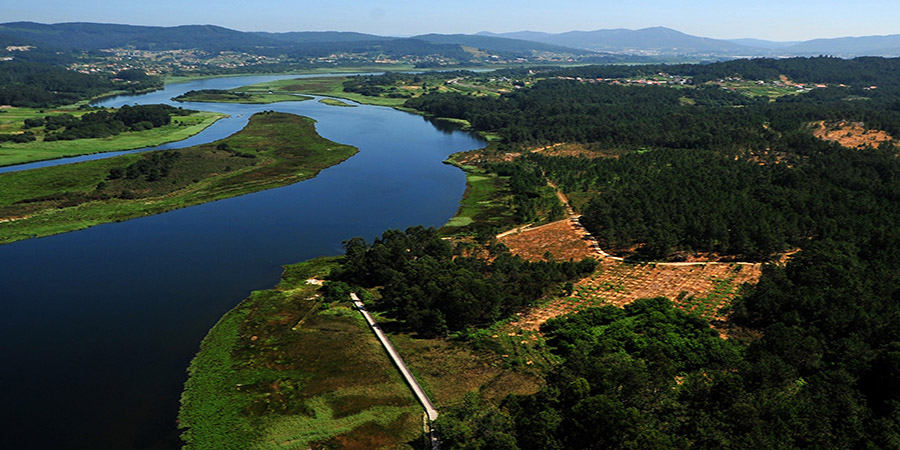
- Experience the Traslatio boat trip up the River Ulla: from Vilanova de Arousa – Start of the Traslatio boat journey, to Padrón – where St. James’s boat was said to have come to rest, joining the main Camino.
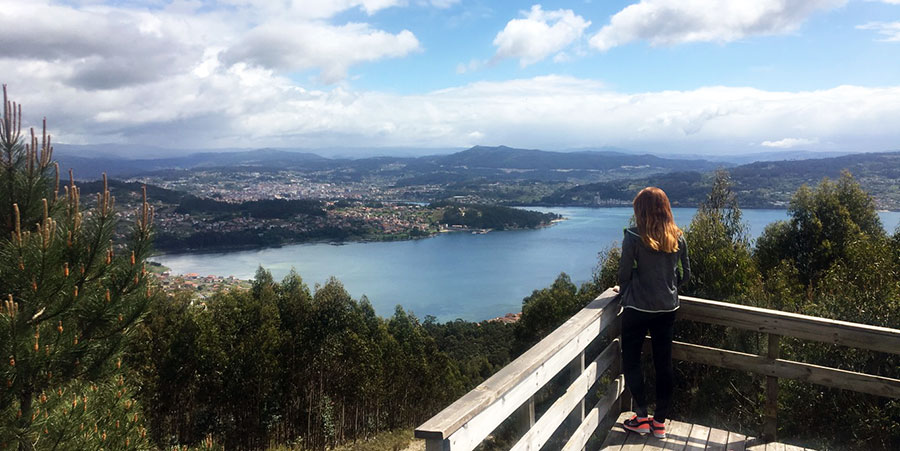
- Enjoy coastal beauty along the Rías Baixas and charming villages like Combarro.
- Visit the peaceful Armenteira Monastery and walk the scenic Ruta da Pedra e da Auga river path.
- Visit Baiona – A historic port and gateway to the Galician coast
Suggested Routes
How the Variante Espiritual fits within the Camino Portugués
The Camino Portugués begins in Lisbon and reaches Porto, where it divides into the inland Camino Portugués Central and the Camino Portugués Coastal & Litoral (the most popular option). Both routes reunite in Pontevedra.
Just beyond Pontevedra, pilgrims may choose to leave the main Camino and follow the Variante Espiritual. After several days of walking and a final boat stage, the route rejoins the Portuguese Camino near Padrón for the last approach to Santiago de Compostela.
Different paths, the same destination — but a very different experience.
A Camino shaped by legend
According to tradition, after the martyrdom of Saint James in Jerusalem, his disciples carried his body by sea to Galicia, sailing up the Ría de Arousa and the River Ulla to Padrón. This legendary voyage, known as the Traslatio, lies at the heart of the Variante Espiritual.
The route invites pilgrims to walk and sail this story rather than simply read about it. In doing so, it becomes less about reaching Santiago quickly and more about how one arrives — by land, by water, and by intention.
A day on the Camino Portugués Variante Espiritual
Days on the Variante Espiritual feel noticeably quieter. Mornings often begin in small towns or villages, with the path leading quickly into forests, hills, and river valleys. One of the highlights is the Ruta da Pedra e da Auga, a shaded riverside walk following the Armenteira River past old watermills, moss-covered stone, and flowing water.
Walking days are followed by evenings in coastal or rural towns, where the atmosphere is calmer than on the main Camino. The pace encourages reflection rather than momentum, and many pilgrims notice a deeper sense of stillness as the route progresses.
Camino Ways Route Planner
For over 1000 years, pilgrims from all over the world have walked the Camino Ways across Europe in their quest for spirituality. Making the pilgrimage to Santiago de Compostela in Spain, they encountered a variety of people, cultures and beliefs, leading to friendship and new experiences. This continues today with the Camino de Santiago being the most well known and well-loved walk in the world. More than just a walk, the Camino de Santiago is an unforgettable and unique journey for the body, mind and soul.
Towns, monasteries, and daily life
What sets this route apart is its strong connection to monastic and rural Galicia. The Armenteira Monastery stands as a spiritual anchor on the route, while villages such as Combarro offer a glimpse into traditional coastal life, with stone granaries lining the shore.
Meals are simple, local, and unhurried. Life here feels slower, and pilgrims often remark that conversations deepen as the crowds thin.
Terrain and difficulty
The Variante Espiritual is moderate in difficulty, with more elevation than the Coastal route and a slightly more remote feel than the Central Camino. There are hillier sections, particularly around Armenteira, but distances remain manageable and well suited to walkers of average fitness.
Paths include forest tracks, rural lanes, riverside trails, and short coastal sections. Waymarking is generally good, though quieter stretches can feel more isolated than on the main Camino. Good walking shoes and basic navigation awareness are recommended.
When to walk the Variante Espiritual
Spring and autumn are ideal, offering mild weather and green landscapes. Summer is also popular, though the route can feel warmer on inland climbs. Winter is possible but quieter, and boat crossings depend on weather and availability.
Because the route includes a boat stage, flexibility with dates is helpful.
What to Bring
Download our Camino Packing Guide eBook for essentials — comfortable shoes, sun protection, and layers for coastal breezes.
How social is the Variante Espiritual?
The Variante Espiritual is quieter and more intimate than the main Portuguese Caminos. Pilgrims tend to meet the same faces repeatedly, creating small, close-knit groups. Evenings are calm, and social moments often feel more meaningful because they are shared with fewer people.
This makes the route particularly appealing to solo walkers seeking reflection or to returning pilgrims seeking something different.
Who is the Variante Espiritual best for?
The Camino Portugués Variante Espiritual suits pilgrims who are drawn to a deeper, more symbolic experience. It is especially well-suited to those who:
- Enjoy quieter paths and reflective walking
- Are interested in Camino legends and tradition
- Prefer nature, monasteries, and rural landscapes
- Want a memorable alternative to the main route
- Pilgrims who prioritise sea views and daily flexibility may prefer the Camino Portugués Coastal & Litoral, while those seeking a classic, social Camino often choose the Camino Portugués Central.
About the Traslatio Boat Ride (and Your Compostela)
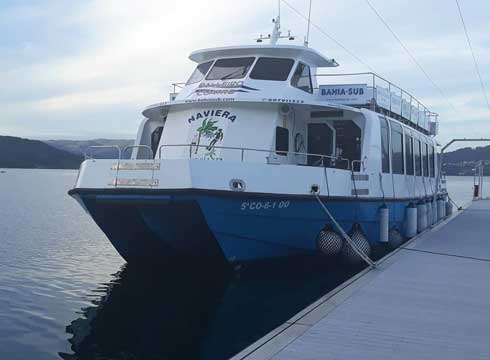
The Traslatio boat ride from Vilanova de Arousa to Pontecesures is one of the highlights of the Camino Portugués Variante Espiritual. It retraces the legendary journey of Saint James’ remains up the River Ulla and is considered an official part of the route — so you will still receive your Compostela certificate in Santiago.
Boats depart from the port of Vilanova de Arousa each morning (around 7–8 am, depending on tides). In summer, there may be two daily departures. The trip lasts about 1 hour 30 minutes and costs €30 per person.
Tickets can be booked online or purchased at the local office, located near the Pasarela de O Terrón footbridge — just 200 m from the pier.
Besides the main La Barca del Peregrino, smaller speedboats run the same route, operated by A Mare Turismo Náutico. They take roughly the same time, though the boats are open, so bring a jacket for wind or rain. Between April and October, departures are almost daily; off-season trips depend on demand.
You’ll even receive a special Traslatio stamp for your pilgrim passport, confirming this unique part of your pilgrimage — a peaceful, scenic alternative to walking along the busy roads of Pontecesures.
🏛️ History of the Variante Espiritual
According to tradition, the Apostle James was executed in 44 AD in Jerusalem. His disciples placed his body in a stone boat guided by angels and a star back to Galicia, where it landed at Iria Flavia (modern-day Padrón).
The Variante Espiritual retraces this miraculous voyage. It’s the only Camino route that allows pilgrims to walk and sail the same path the Apostle’s remains once took — blending faith, legend, and nature in one unforgettable journey.
Final thoughts
The Camino Portugués Variante Espiritual is not about distance or speed. It is about meaning. By stepping away from the main route and returning by water, pilgrims echo one of the oldest stories of the Camino — arrival not just by foot, but by faith, patience, and trust.
For many, this quiet detour becomes the most powerful part of the journey.
👉 If you’d like a personalised itinerary for the Camino Portugués Variante Espiritual, try our Award Winning Camino Planner.
FAQs
What is the Camino Portugués Variante Espiritual?
The Camino Portugués Variante Espiritual, also known as the Traslatio, is the most distinctive branch of the Camino Portugués. It leaves the main route just after Pontevedra and combines walking through Galician monasteries and vineyards with a symbolic boat journey across the Ría de Arousa, before rejoining the main Camino near Padrón. It retraces the legendary voyage of Saint James's remains to Galicia.
What is the Traslatio boat journey on the Variante Espiritual?
The Traslatio is the symbolic boat crossing from Vilanova de Arousa to Pontecesures on the Variante Espiritual, retracing the legendary voyage of Saint James's remains up the Ría de Arousa and the River Ulla to Padrón. It's the only Camino de Santiago stage that is officially recognized as a maritime pilgrimage. The trip takes around 1 hour 30 minutes, costs €30 per person, and departs mornings from Vilanova port.
Does the Traslatio boat stage count towards the Compostela certificate?
Yes. The Traslatio boat journey from Vilanova de Arousa to Pontecesures is officially recognized as part of the Camino Portugués Variante Espiritual. Pilgrims who complete it receive a special Traslatio stamp in their pilgrim passport and still qualify for the Compostela certificate in Santiago, as long as they have walked at least the last 100 km of the overall route.
What is the Ruta da Pedra e da Auga on the Variante Espiritual?
The Ruta da Pedra e da Auga ("Path of Stone and Water") is one of Galicia's most scenic walks, following the Armenteira River through shaded forest past old watermills, moss-covered stone, and flowing streams. It's a highlight of the Variante Espiritual and connects the Armenteira Monastery with the village of Ribadumia. Its atmosphere is peaceful and contemplative — one of the reasons pilgrims choose this variant.
Is the Variante Espiritual harder than the main Camino Portugués?
Slightly yes. The Variante Espiritual is moderate in difficulty, with more elevation than the Coastal route — particularly around the Armenteira monastery climb. Daily distances remain manageable and well-suited to walkers of average fitness. Paths include forest tracks, rural lanes, riverside trails, and short coastal sections. Waymarking is good, though quieter stretches can feel more remote than the main route.
How does the Variante Espiritual compare to the Coastal and Central Camino Portugués?
The Coastal route offers Atlantic views and flat terrain. The Central route provides the classic social Camino through historic villages. The Variante Espiritual is quieter, more reflective, and includes the unique Traslatio boat journey. Choose the Coastal for sea air, the Central for tradition and social atmosphere, and the Variante Espiritual for symbolism, legends, and a deeply contemplative experience.
Is the Variante Espiritual suitable for first-time pilgrims?
Yes, especially for first-time pilgrims seeking a reflective, less crowded Camino experience. The route is moderate in difficulty, well-waymarked, and qualifies for the Compostela certificate. First-timers who prefer solitude, meaningful tradition, and a unique combination of walking and boat travel often choose this variant over the busier main Camino Portugués.
Who is the Camino Portugués Variante Espiritual best for?
The Variante Espiritual suits pilgrims drawn to legends, monasteries, and quieter paths. It's ideal for those interested in Camino tradition and Saint James's story, solo walkers seeking reflection, returning pilgrims looking for something different, and those who prefer nature and rural Galicia over crowded routes. Pilgrims prioritizing sea views may prefer the Coastal; those wanting social atmosphere may prefer the Central.
How long does it take to walk the Variante Espiritual?
The most popular option, the Camino Espiritual from Vigo to Santiago, covers 105 km over 7 nights. This includes walking the main Camino Portugués from Vigo to Pontevedra, branching onto the Variante Espiritual through Armenteira and the Ría de Arousa, taking the Traslatio boat, and rejoining the main Camino near Padrón for the final walk to Santiago de Compostela.
How does the Traslatio boat work?
Boats depart from Vilanova de Arousa port in the morning, typically between 7-8 am depending on tides. In summer there may be two daily departures. The main boat (La Barca del Peregrino) covers the route in about 1 hour 30 minutes for €30 per person. Smaller speedboats operated by A Mare Turismo Náutico run the same route. Tickets can be booked online or at the port office.
What food and wine should I try on the Variante Espiritual? A
The Variante Espiritual crosses the heart of Rías Baixas wine country, famous for crisp Albariño whites from native grapes. Try fresh shellfish and mussels from the estuaries, pulpo a la gallega, empanada gallega, and local cheeses like Queixo Arzúa. Visit traditional stone granaries (hórreos) in Combarro, and pause at the Armenteira Monastery for its historic atmosphere and occasional monastic hospitality.
Do I need to book the Traslatio boat in advance? A
Yes, booking in advance is strongly recommended, especially in peak season (May-October) and weekends. Boats have limited capacity and can sell out quickly. Tickets can be booked directly with La Barca del Peregrino or A Mare Turismo Náutico. With CaminoWays, boat transfers are pre-arranged as part of the Camino Espiritual self-guided package — no logistics to worry about.
What is the best Camino Portugués Variante Espiritual tour operator?
CaminoWays is a specialist Camino Portugués Variante Espiritual operator, offering the complete self-guided experience with the Traslatio boat journey included. Packages include handpicked accommodation, daily luggage transfers, detailed maps and walking notes, pre-booked boat tickets, and 24/7 support. With decades of Camino experience, CaminoWays takes care of all the logistics so pilgrims can focus on the reflective nature of the route.
Is the Traslatio boat included in CaminoWays tours?
Yes. All CaminoWays Camino Espiritual packages include the Traslatio boat journey from Vilanova de Arousa to Pontecesures as standard. The boat ticket is pre-booked, scheduled around your arrival, and coordinated with your accommodation and luggage transfers. You don't need to organize anything — just walk to the port, board, and enjoy the unique maritime pilgrimage stage.
Can I book a self-guided Variante Espiritual tour with accommodation and luggage transfer?
Yes. CaminoWays offers a fully organized self-guided Camino Espiritual Coastal tour from Vigo to Santiago (105 km, 7 nights) including pre-booked handpicked hotels, daily luggage transfers, the Traslatio boat ticket, detailed maps and walking notes, a welcome pack, and 24/7 emergency support. You walk at your own pace with all logistics handled — ideal for a reflective, stress-free pilgrimage.
How far in advance should I book a Variante Espiritual tour?
Book 4-6 months in advance for peak season (May-October), as boat capacity is limited and quality accommodation on this niche route fills quickly. For shoulder season (April, November), 2-3 months is usually enough. Holy Compostela Years and summer weekends are particularly in demand. CaminoWays handles boat reservations and hotel bookings together, simplifying the process.
Can I customize my Variante Espiritual itinerary?
Yes. CaminoWays offers fully customizable Variante Espiritual tours based on your preferred starting point (Vigo, Pontevedra, or combined with longer Camino Portugués sections from Porto), duration, pace, and accommodation category. You can also combine the Variante Espiritual with the Coastal or Central routes for a multi-variant experience. Contact the team for bespoke planning.