
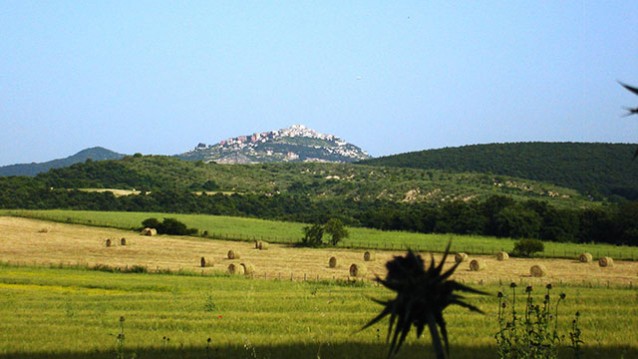
While walking in Tuscany, you will be rewarded with wonderful picture-perfect landscapes: lush fields dotted with terracotta farmhouses, vineyards that stretch for miles, and rolling hills topped with vertigo-defying castles and medieval villages. Your taste buds will also be treated to the superb local food and wine after your walk — Tuscany is the land of Chianti, white truffles, and the immensity of delicious cured meats.
For a personal account of what it’s like to cycle through these places, read Claire’s highlights from the Via Francigena in Tuscany.
While walking in Tuscany, you will be rewarded with wonderful picture-perfect landscapes: lush fields dotted with terracotta farmhouses, vineyards that stretch for miles, and rolling hills topped with vertigo-defying castles and medieval villages.
Your taste buds will also be pleased to be treated to the superb local food and wine after your walk: Tuscany is the land of Chianti, white truffles, and the immensity of delicious cured meats. Besides all that, these are some of the most spectacular places you will find while walking the Via Francigena in Tuscany.
Table of contents
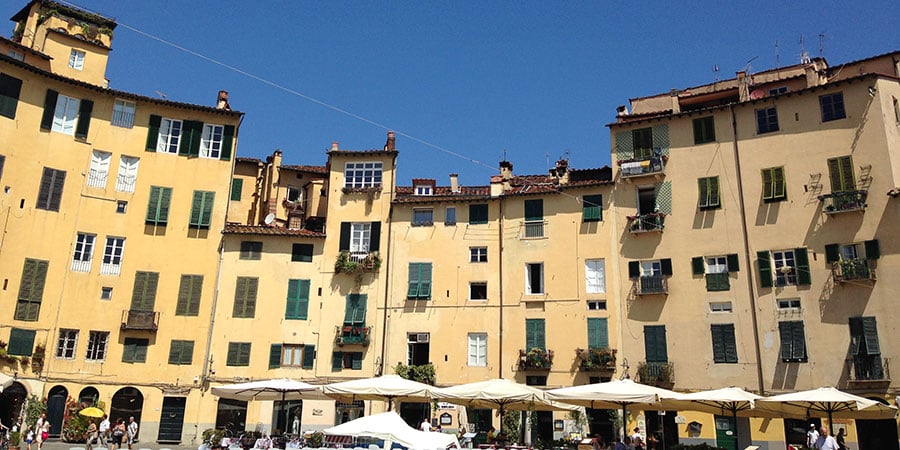
1. Musical Lucca, spectacular places on the Via Francigena
Lucca is the starting point of our most popular section of the Via Francigena. While this section’s most stunning part starts once you reach San Miniato, Lucca is a city that shouldn’t be missed, even if you decide to start your walk further ahead. Lucca’s most striking feature is its 16th-century 4km-long wall, wrapping itself all around the old town. The wall is perfect to go for a jog, a walk or a cycle. Inside the wall, explore its cobbled streets and piazzas, admire the San Martino cathedral or simply relax and watch the world go by with a cup of coffee or a gelato.
Lucca is also the birthplace of Giacomo Puccini. The city takes its musical heritage seriously — the summer festival held in his honour draws musicians and visitors from across Europe. Arriving in Lucca the evening before your first stage and spending a few hours in the city is the ideal way to start the journey south.
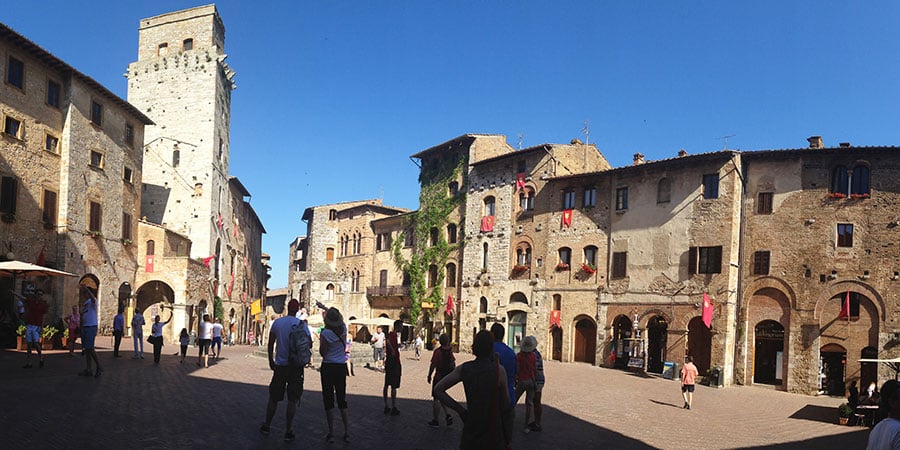
2. San Gimignano of the beautiful towers
As you approach the end of your walking day, the 14 medieval towers of San Gimignano will come into view. It is an impressive and imposing sight for Via Francigena pilgrims arriving in ‘San Gimignano delle belle Torri’, San Gimignano of the beautiful towers on foot. This now UNESCO-listed hilltop town was once controlled by two rival families who built 72 tower houses, as a symbol of their wealth and always trying to outdo each other. 14 of those towers remain (of up to 54 metres), giving the town its unique medieval look. It is also believed, it was this rivalry that gave Shakespeare his idea for the plot of Romeo and Juliet.
It is also believed that the rivalry between San Gimignano’s warring families gave Shakespeare his idea for the plot of Romeo and Juliet.
3. Pocket-sized Monteriggioni
Monteriggioni is small in size but makes a big impression. This tiny village was an important walled castle and remains intact since the 13rd century, welcoming pilgrims into its central square where you will find the Church of Santa Maria Assunta and a couple of cafes where you can relax.
Walking through the main gate and into the central square, where you’ll find the Church of Santa Maria Assunta and a couple of cafes perfectly positioned for tired pilgrims, feels genuinely medieval. The scale of the place is intimate rather than overwhelming, which makes it one of the most charming stops on the route.
You can take a tour of the walls to enjoy panoramic views across the surrounding Sienese countryside. Each July, Monteriggioni also hosts a Medieval Festival, one of the most atmospheric and well-attended in the region, when the village fills with people in period costume and the square comes alive with music, jousting, and market stalls.
4. Majestic Siena
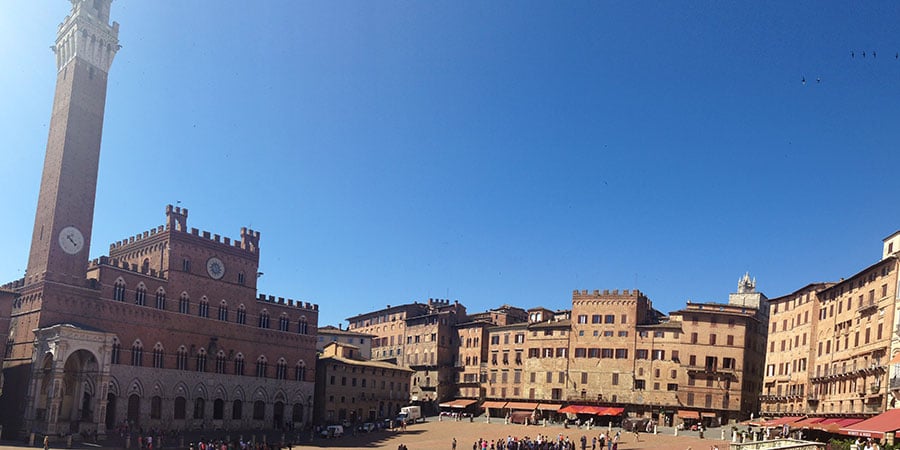
UNESCO-listed Siena is one of Italy’s most visited cities and for a good reason. The historic centre of Siena is listed as a UNESCO site for its amazingly preserved medieval structure and Gothic architecture, built around the central Piazza del Campo. This curved square is home to the Palazzo Pubblico and its tower, as well as hosting the heart-stopping Palio di Siena horse race in July and August. The classic Tuscan cathedral, or Duomo, and the Museo Civico are also a must-see in Siena.
The Campo is home to the Palazzo Pubblico and the Torre del Mangia, its 88-metre tower. It is also the stage for the Palio di Siena — the bareback horse race held twice a year in July and August, which has been running almost uninterrupted since 1644. The Siena Cathedral, or Duomo, is one of the masterpieces of Italian Gothic architecture, with a floor of extraordinary inlaid marble and works by Michelangelo, Donatello, and Pinturicchio inside.
Most pilgrims who arrive in Siena at the end of their walk choose to add at least one extra night before heading home or continuing south. This is the right decision. For a complete guide to what to see and do in the city, read our top things to do in Siena guide.
5. Outstanding Val d’Orcia
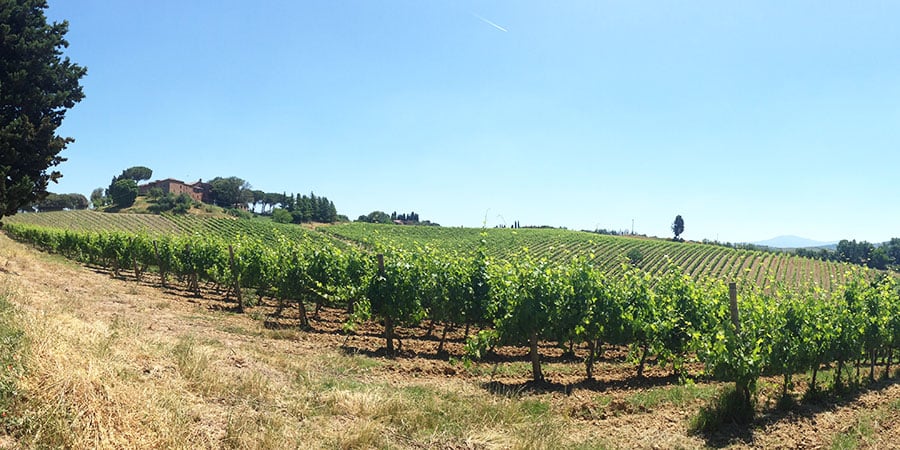
After Siena, the Via Francigena enters the Val d’Orcia, a UNESCO-listed region of outstanding natural beauty and landscapes carefully designed in the Renaissance. Here you will find the classic Tuscan white tracks weaving paths among the ever-stretching vineyards. Peaceful farmhouses lined by cypress trees, hilltop castles, and medieval villages dot this historic and idyllic countryside.
Here you will find the classic Tuscan white tracks (the famous strade bianche) weaving paths through ever-stretching vineyards. Peaceful farmhouses lined by cypress trees, hilltop castles, and medieval villages like Montalcino, San Quirico d’Orcia, and Radicofani dot this historic and deeply beautiful countryside.
The Val d’Orcia section of the Via Francigena is less walked than Tuscany to the north, which makes it all the more rewarding for those who continue south. For pilgrims walking the full route to Rome, this is where the journey opens out into something quieter and more ancient: less picturesque postcard, more genuinely medieval road.
At CaminoWays we can advise on the best sections for your trip and your holiday can be completely tailor-made. For more information about walking the Via Francigena in Tuscany, see our Lucca to Siena itinerary or use our Camino Planner.

FAQ: Spectacular Places on the Via Francigena in Tuscany
What are the must-see places on the Via Francigena in Tuscany?
The five highlights that most pilgrims rate highest are Lucca, San Gimignano, Monteriggioni, Siena, and the Val d’Orcia. Each offers something different — Lucca for its walls and music, San Gimignano for its medieval towers, Monteriggioni for its intact fortifications, Siena for its Gothic architecture and the Palio, and the Val d’Orcia for its UNESCO-listed landscape.
Which section of the Via Francigena in Tuscany is most popular?
The Lucca to Siena section — 133 km over 7 nights — is the most popular stretch of the entire Italian route. It covers all five places in this guide and is widely considered the definitive Via Francigena experience.
Is the Val d’Orcia on the Via Francigena?
Yes. The Via Francigena passes directly through the Val d’Orcia after leaving Siena, continuing south through Viterbo and eventually into Rome. The Val d’Orcia section is part of the full Via Francigena from Lucca to Rome.
How long does it take to walk through these five places?
The Lucca to Siena section takes 7 nights and covers all five highlights. The shorter San Miniato to Siena option takes 6 nights and includes San Gimignano, Monteriggioni, and Siena.
When is the best time to visit these places on the Via Francigena?
Spring and autumn are ideal for all five. Siena in July or August adds the Palio, but the heat can make walking uncomfortable. Autumn brings the truffle and wine harvests, making the food along the route exceptional. For full timing detail, see our best time to walk the Via Francigena guide.
