
The Via Francigena is one of Europe’s oldest pilgrimage routes, nearly 2,000 km from Canterbury in England to Rome, crossing France, Switzerland, and Italy. You don’t have to walk the whole thing. To receive the official pilgrim certificate, the Testimonium, you need to walk just the last 100 km on foot into Rome. And the walk that qualifies is one of the most rewarding weeks you can spend in Italy.
The Last 100km: Viterbo to Rome
The section that qualifies for the Testimonium begins in Viterbo — a beautifully preserved medieval city in the Lazio region, 112 km north of Rome. Starting here gives you comfortable margin over the 100 km minimum and a full six days of walking through the Lazio countryside before arriving at St Peter’s Square.
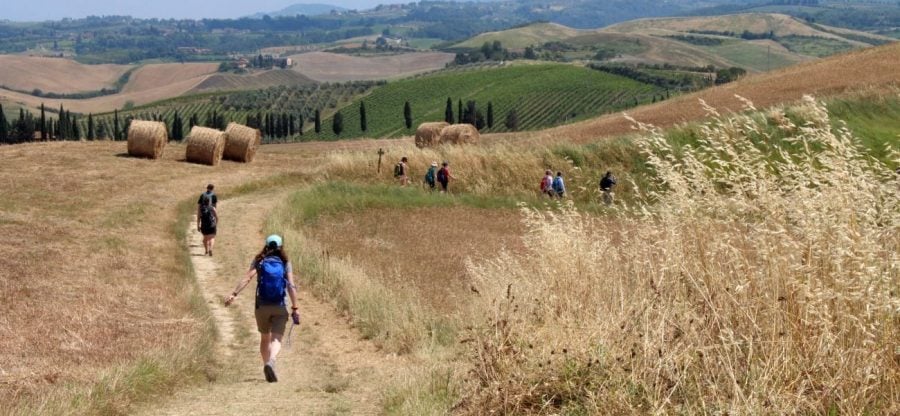
The Viterbo to Rome itinerary takes pilgrims along footpaths, ancient Roman roads, and forest trails through the rolling green hills of Lazio. Along the way you pass through lively small towns and villages — with their street markets, local restaurants and centuries of history, staying in family-run country hotels and agriturismos each night.
Highlights of the route include the Etruscan ruins of Sutri, carved directly into the volcanic rock, the sanctuary at Campagnano di Roma, and on the final day, the extraordinary approach into Rome from Monte Mario, where the dome of St Peter’s Basilica appears on the horizon for the first time. Walkers arrive in the Vatican along the ancient Via Triumphale, entering St Peter’s Square on foot after six days on the road.
What Is the Testimonium?
The Testimonium — full name Testimonium Peregrinationis ad Limina Petri — is the official pilgrim certificate of the Via Francigena, equivalent to the Compostela on the Camino de Santiago. It is awarded in Rome to pilgrims who have walked at least the last 100 km of the Via Francigena on foot, or cycled the last 200 km.
To receive it you need a stamped pilgrim passport (known as the credenziali) collected and stamped daily at hotels, churches, restaurants, and monasteries along the route. On arrival in Rome, you present your stamped credenziali at St Peter’s Basilica, following the signs for the Percorso Preghiera (Prayer Route) on the right side of the Basilica. The Testimonium itself is free, though a small donation is welcomed.

Attending a Papal Audience
For pilgrims arriving in Rome, attending a Papal Audience is a meaningful way to mark the end of the journey. General audiences are typically held on Wednesday mornings at the Vatican — in St Peter’s Square in warmer months, or in the Paul VI Audience Hall when the weather requires it. Attendance is free of charge and open to all.
Requests for audience tickets should be made in advance through the Prefecture of the Papal Household via the Vatican’s official website. Availability is not guaranteed and demand during peak pilgrimage seasons can be high, so submitting your request well before your arrival date is advisable.
The Jubilee and What it means for Pilgrims
2025 was a Jubilee Year — the Catholic Church’s Ordinary Holy Year, declared every 25 years, which drew record numbers of pilgrims to Rome under the theme Pilgrims of Hope. During a Jubilee, pilgrims who walk to Rome and fulfil certain spiritual conditions receive a plenary indulgence, adding a further layer of significance to the arrival in the Eternal City.
The next Ordinary Jubilee will be in 2050. But Rome retains its full spiritual weight for pilgrims in every year. Walking into St Peter’s Square after days on the road is an experience that doesn’t require a Holy Year to be profound and the Testimonium is awarded year-round to all who complete the required distance. For the full background on the Jubilee tradition and what it means for walkers on the Via Francigena, see our pilgrimage to Rome guide.
What to Expect on the Walk
The Viterbo to Rome section covers 112 km over 5 walking days and 6 nights. The terrain is moderate, a mix of Roman roads, forest trails, dirt tracks and some rolling hills — manageable for most walkers with reasonable fitness. Daily distances average around 20–22 km.
Accommodation throughout the walk is in hand-picked hotels, guesthouses, and agriturismos, all with private bathrooms. Luggage transfers are included as standard, so you walk each stage carrying only a daypack. The final night is spent in central Rome, within easy walking distance of St Peter’s Square.
The best months for this section are April to October, spring and autumn offer the most comfortable walking conditions, though the route can be walked year-round on this lower section. For full timing detail see our best time to walk the Via Francigena guide.
Ready to Walk to Rome?
The Viterbo to Rome itinerary is available as a self-guided or guided walk, with all accommodation, luggage transfers, maps and 24/7 support included. Use our Camino Planner to check dates and availability, or contact our travel specialists to plan your pilgrimage to Rome.
For more on what walking to Rome feels like, read journalist Gavin Gough’s personal account: A Pilgrimage to Rome on the Via Francigena. And for the complete planning guide: routes, stages, the Testimonium and the Jubilee, you can see our Via Francigena pilgrimage guide
