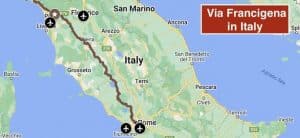
The Via Francigena is one of Europe’s great pilgrimage routes — a 2,000km+ journey on foot from Canterbury, England to Rome, Italy. If you’re serious about this challenge, here is everything you need to know before you lace up your boots.
This epic trail, following the pilgrimage route taken by Sigeric the Serious, Archbishop of Canterbury, back in the 10th century, crosses regions of spectacular beauty, such as the Alps and Tuscany, as well as cultural and historical landmarks such as the Champagne region and Great War battlefields of Northern France. But how long does it take to complete the Camino to Rome?
The Via Francigena traces the exact route walked by Sigeric the Serious, Archbishop of Canterbury, in 990 AD. Crossing four countries, it leads pilgrims through some of Europe’s most awe-inspiring landscapes: the high Alpine passes, the rolling hills of Tuscany, the Champagne vineyards of northern France, and the haunting WWI battlefields of the Somme. This is not just a walk — it is a living history lesson and a profound personal journey.
Walking the full Via Francigena takes approximately 100 days (99 nights, 98 walking days), covering between 14 and 30 km per day across 16 sections.
For pilgrims who prefer a steadier pace, the longest daily stages can be split, extending the journey to 106 days in total. We strongly recommend building in at least one rest day per week — your body will thank you by the time you reach Tuscany.
Via Francigena Walking: Key Facts
Total distance: 2,000km+
Duration: 98–106 walking days
Daily distance: 14–30 km per day
Sections: 16 walking sections
Rest days: Recommended weekly
If you want to walk to Rome, following in Sigeric’s footsteps, it will take you 100 days (99 nights – 98 walking days) to complete the 16 sections with no rest days, walking between 14 and 30kms per day. You also have an option to ‘split’ the longest walking days in two in certain sections, taking you 106 days to complete. For such an epic journey, we recommend taking a rest day at regular intervals (for instance, once per week or at the end of each section).
Cycling will get you to Rome a bit faster. However, we only recommend taking up the challenge if you are a keen cyclist. You can complete the Via Francigena from Canterbury to Rome over 44 days (43 nights – 42 cycling days), cycling between 27 and 73kms per day. At Camino Ways, we have divided the Via Francigena route into eight cycling sections. Some cycling days can also be merged if you feel your cycling skills can handle longer distances, so talk to the team.
Can I Walk Just Part of the Via Francigena?
Absolutely. Each of the 16 walking sections can be completed independently, typically over 5 to 10 days. The most sought-after stretches among pilgrims are:
The Alps — dramatic high-altitude terrain and breathtaking mountain passes
Tuscany — iconic rolling landscapes, medieval hill towns, and vineyards
You choose your start and end points; the pilgrimage adapts to your life.
While you might not be able to walk for 100 days, it doesn’t mean you can’t experience the Via Francigena. We have divided the Camino to Rome into 16 walking sections that can be completed in five to ten days; and eight cycling sections from 6 to 11 days. You can also pick your starting and finishing points and adapt the itinerary to your available time.
Contact our travel specialists for more information about the Via Francigena route or to plan and book your Camino to Rome trip.
Can I Walk Just Part of the Via Francigena?
Absolutely. You don’t need 100 days to experience this pilgrimage. CaminoWays offers several independent sections that can be completed in a week, each with its own character and pace:
Via Francigena in Tuscany: Lucca to Siena — 133 km, 7 nights. The most popular section on the entire route. Rolling hills, olive groves, the medieval towers of San Gimignano, and a finish in Siena, a UNESCO World Heritage city.
Easy Via Francigena: San Miniato to Siena — 86 km, 6 nights. A gentler pace through the Tuscan countryside, averaging 15 km per day — ideal for those seeking a more leisurely pilgrimage.
The Last 100km: Viterbo to Rome — 112 km, 6 nights. The most emotionally powerful stretch of the entire route — and the one that earns you the Testimonium, the official pilgrim certificate.
Full Italian Route: Lucca to Rome — 419 km, 20 nights. For pilgrims who want the full Italian experience, from the walls of Lucca to the steps of St. Peter’s.
Cycling the Via Francigena: Lucca to Rome — 11 nights by bike. Cover more ground in less time — ideal for experienced cyclists who want to take on the full Italian stretch.
You choose your start and end points; the pilgrimage adapts to your life, not the other way around.
If you’d like to walk to Rome, following in Sigeric’s footsteps, it will take you 100 days (99 nights – 98 walking days) to complete the whole route, walking between 14 and 30 km per day.
You also have an option to ‘split’ the longest walking days in two in certain sections, taking you a total of 106 days to complete. For such an epic journey, we also recommend taking a rest day at regular intervals (for instance once per week).
For more information about the Via Francigena route or to plan and book your Camino to Rome trip, contact our travel specialists.
FAQ How long is the Via Francigena?
Can I walk just part of the Via Francigena?
Yes. The route can be divided into independent sections, each completable in one to two weeks. You can start and finish wherever suits your schedule — no need to walk the full 2,000km.
What are the most popular walking sections?
The three most popular sections with CaminoWays pilgrims are:
Yes. The full Italian route from Lucca to Rome covers 419 km over 20 nights — ideal for pilgrims who want to walk the entire Italian stretch without committing to the full Canterbury–Rome journey.
The Testimonium is the official pilgrim certificate of the Via Francigena, equivalent to the Compostela on the Camino de Santiago. To earn it, you must walk at least the last 100 km into Rome — stamp your pilgrim passport (credenziali) at hotels, churches, and monasteries along the way.
Can I mix walking and cycling?
Absolutely. CaminoWays can tailor a combined itinerary — start on foot in Tuscany, pick up a bike for a stretch, and finish walking into Rome. Contact the team to build your route.
When is the best time to walk the Via Francigena?
Spring (April–June) and autumn (September–October) offer the best conditions across all sections. Summer is possible but can be hot in Tuscany and Lazio. The Viterbo–Rome section is walkable most of the year.
Maria is from Viveiro, in the misty and beautiful northern coast of Galicia, and now calls Ireland her adopted home. She adores Santiago, where she studied Journalism at Santiago de Compostela University. She also loves travel, food, books, and arty and crafty. She has walked and cycled many trails including many Camino routes, Japan's Kumano Kodo, the Kerry Camino in Ireland and many others.