
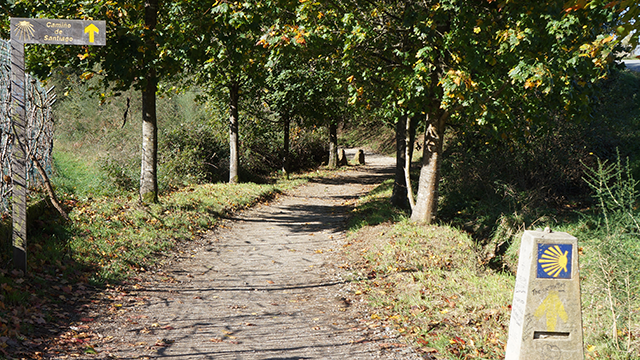
Lavacolla: the pilgrims washing place
Lavacolla is a village about 10km from Santiago de Compostela, on the final stage of the Camino Francés. Medieval pilgrims stopped here to wash in the stream before entering the holy city, a custom recorded in the 12th-century Codex Calixtinus. Today the village is best known as the home of Santiago’s international airport, which sits around 2km before it on the road.
Where Lavacolla is on the Camino
Lavacolla falls on the last day of walking, roughly 10km from the cathedral. Pilgrims arriving from O Pedrouzo pass through in the morning and reach Santiago de Compostela by early afternoon.
A few kilometres further on comes Monte do Gozo, the hill where walkers catch their first sight of the cathedral spires — about 4.5km from the centre. You can trace the final approach on our Camino Francés map.
Almost everyone walking the last 100km from Sarria passes through Lavacolla, as do pilgrims on the full route from St Jean and those arriving on other ways from the east.
Where the name comes from
There are three explanations, and they are not equally well documented.
- The Codex Calixtinus. The 12th-century pilgrim’s guide calls the place Lavamentula and describes French pilgrims washing themselves in the stream out of devotion to the Apostle — not only their private parts, it says, but the dirt of the whole body, clothes removed. It is the earliest written account, and rather more earthy than the version usually told to visitors.
- The polite version. Guides on the cathedral rooftop tour in Santiago often explain the name as lavar (to wash) and cuello (neck) — pilgrims washing their necks to arrive clean before the Apostle. Tidier, and almost certainly a later softening.
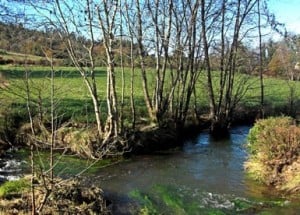
- The pre-Roman version. Scholars have proposed lava colea, where lava means river and colea refers to rounded stones — the river of smooth stones. It matches the character of the stream, which runs downhill as A Sionlla before joining the River Tambre.
Whichever you prefer, the washing tradition is real and documented and it explains why this unremarkable village has a name every pilgrim remembers.
Arriving clean: why it mattered
By Lavacolla, a pilgrim from France had walked for weeks. The stop was practical as much as devotional — nobody wanted to enter the cathedral filthy after 800km. Washing here marked the transition from the road to the destination, the last act of the journey before Monte do Gozo and the city itself.
The Camino is full of these threshold moments. Walkers leave a stone at the Cruz de Ferro in León, cross into Galicia at O Cebreiro, and pass the oldest cruceiro in Galicia at Melide. Further east, Santo Domingo de la Calzada has its miracle of the hen and Navarre the legend of the Puente de la Rabia.
The airport
Santiago–Rosalía de Castro airport is still known to most locals simply as Lavacolla. It is the arrival point for many pilgrims flying in to walk the last 100km, and the departure point for most walking home afterwards — which means a good number of pilgrims pass Lavacolla twice without realising it is the same place.
Walking the final stage
Lavacolla is included on every itinerary that finishes in Santiago:
- The Camino Francés from Sarria — the classic last 100km, and the shortest route that earns the Compostela
- The last 100km guided tour — the same route with a guide throughout
- The easy Camino Francés — shorter daily distances
- A Camino Francés short break — for a few days rather than a week
- Family walking on the Camino Francés — stages that work with children
Before you set off, it is worth reading how difficult the Camino Francés really is and what to eat along the way. If you are starting in Sarria, our things to do in Sarria and audio guide from Sarria will get you ready, and Portomarín is the first great stop on the way.
FAQ
About 10km, on the final stage of the Camino Francés.
The 12th-century Codex Calixtinus records pilgrims washing in the stream here before entering Santiago and calls the place Lavamentula. Other explanations point to lavar and cuello — to wash the neck — or to a pre-Roman lava colea, meaning the river of rounded stones.
Yes. The custom is documented in the Codex Calixtinus, the earliest guide to the Camino de Santiago.
Yes. Santiago–Rosalía de Castro airport sits around 2km before the village and is still widely known as Lavacolla.
Monte do Gozo, about 4.5km from Santiago, where pilgrims see the cathedral spires for the first time.

What a same that this place has become so insignificant. I walked the camino in 2018 but i wasn’t pointed at this site.