
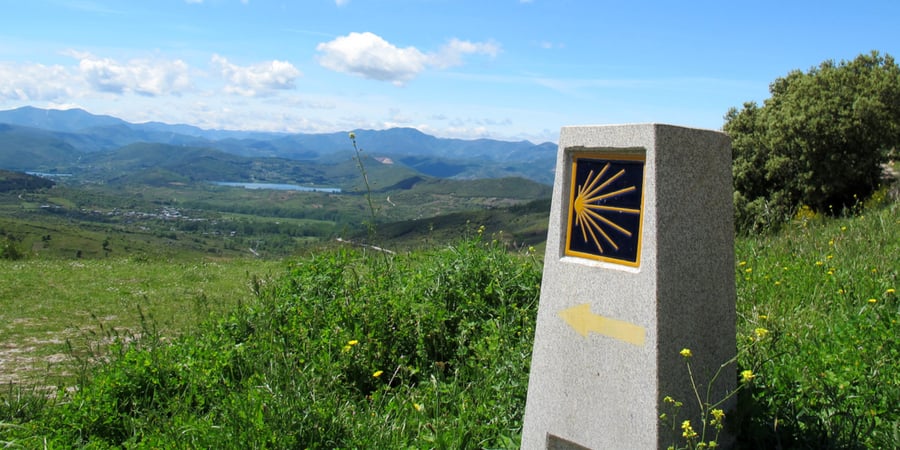
The two main Camino de Santiago waymarks are the yellow arrow and the scallop shell. The yellow arrow always points towards Santiago de Compostela and was created in 1984 by Don Elías Valiña, a parish priest in O Cebreiro. The scallop shell (vieira in Spanish/Galician) is the historic medieval pilgrim symbol, with its lines representing the many Camino routes converging on Santiago. Both symbols guide pilgrims along all official Camino routes, and following them is enough to reach Santiago without any map.
Table of contents
The Meaning of the Scallop Shell on the Camino
The scallop shell is one of the most iconic symbols of the Camino de Santiago. It is still used today to guide pilgrims to Santiago de Compostela along many routes.
Painted or printed on walls, sidewalks, tiles, or Camino markers, the scallop shell (or ‘Vieira’ in Galician and Spanish) will help you find your way.
The scallop shell is one of the most iconic and enduring symbols of the Camino de Santiago. Known as the vieira in Spanish and Galician, it appears everywhere along the route: painted on walls, engraved on stones, tiled into pavements and even hanging from pilgrims’ backpacks.
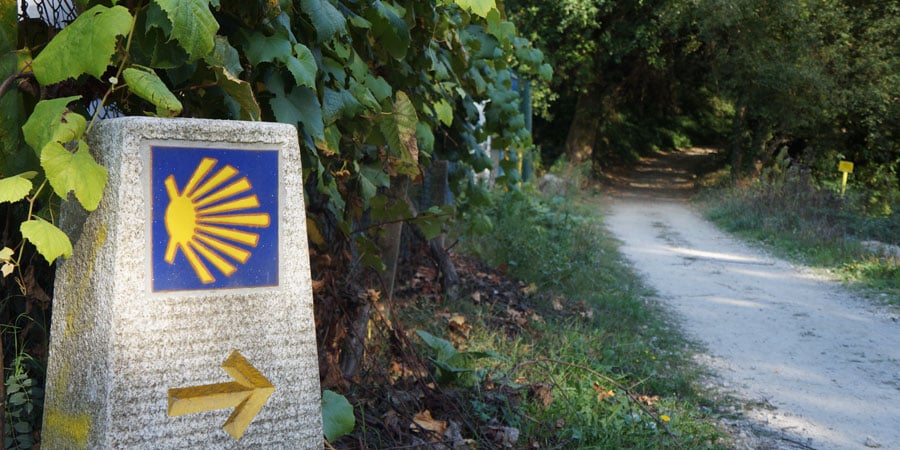
Its meaning goes beyond simple navigation. The scallop shell is believed to be a metaphor, its lines representing the different routes pilgrims travel from all over the world, all trails leading to one point: Santiago de Compostela.
Medieval pilgrims often wore scallop shells attached to their cloaks or hats for their journey to Santiago. More than being just a symbol or a pilgrim badge, the scallop shells also had a practical purpose.It served not only as a sign of their pilgrimage but also had a practical use, the curved shell could be used to scoop water or food along the way.
Today, the scallop shell continues to inspire those walking or cycling the Camino. Whether carved in stone or shining in metal, it’s a reminder that you’re part of something much larger. You can discover more about its origins and symbolism in the story of the scallop shell and the Camino.
The Story Behind the Yellow Arrow
While the scallop shell dates back to medieval times, the yellow arrow is a more recent addition but just as beloved.
The name of Don Elías Valiña Sampedro might not ring any bells. Still, you will certainly recognise his most ‘famous’ creation: the yellow arrow showing pilgrims the way along the Camino de Santiago.
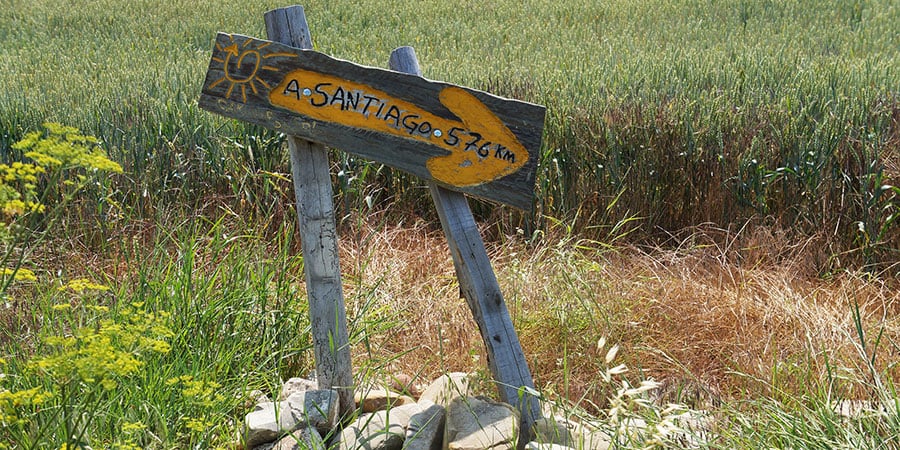
Don Elías was a parish priest of O Cebreiro and a Camino visionary. After years of studying the Way of St James, he was convinced of the importance of this ancient trail and set himself on the challenge of reviving the route we call the Camino Frances. In 1984, he put in motion his mission to rescue, clean and mark the trails along this Camino, starting in Roncesvalles, in the Pyrenees.
In 1984, Don Elías began marking the trail himself, armed with little more than a bucket of yellow paint and his determination to bring the Camino Francés back to life. Legend has it that he drove across northern Spain in his old Citroën, painting arrows wherever the path might confuse pilgrims: on trees, stones, walls and road signs.
Thanks to his vision, the yellow arrow became a universal guide for pilgrims. Today, it’s one of the most recognisable symbols in Europe showing the way to Santiago. You can learn more about its history in the story behind the Yellow Arrow on the Camino de Santiago.
These Camino markings at regular intervals make the routes extremely easy to navigate.
How to Follow the Camino Markings Today – Camino de Santiago Navigation map
Following the Camino de Santiago is easier than ever, thanks to the clear markings found across all routes. The yellow arrows and scallop shells appear at regular intervals along the paths, crossroads and village streets.
Here are a few quick tips:
- Follow the yellow arrow — it always takes priority over other signs.
- Look down in towns and cities — scallop shells are often embedded in pavements.
- When in doubt, continue straight until you find the next arrow or shell.
- Avoid overthinking — if you see other pilgrims ahead, you’re likely on the right track.
We have created a Google map to help you navigate the Camino de Santiago. Once en route. Click on the link and open it in Google Maps. The blue dot will give you your exact position on the way, and the line will show you where to follow the Camino: Open the Camino Navigation Map
If you are a CaminoWays pilgrim and about to embark on the Camino, please visit our client portal for more information:
Why These Symbols Matter to Pilgrims
Beyond their practical purpose, the scallop shell and yellow arrow have become two of the most recognisable signs along the Camino de Santiago. Together, they make it possible for millions of pilgrims each year to find their way.
When you see a yellow arrow or a scallop shell on your journey, you can be sure of one thing: you’re still on the Camino that has guided travellers to Santiago de Compostela for hundreds of years.
For more information about Camino markings and the Camino de Santiago routes or to book your trip, contact our travel specialists.

FAQs About Camino Symbols and Markings
A: It symbolises the many routes pilgrims travel that all lead to Santiago de Compostela.
A: Yes, the yellow arrows and scallop shells appear regularly, making the Camino simple to navigate.
The yellow arrow is the universal waymark of the Camino de Santiago. Painted on walls, trees, stones and pavements, it always points towards Santiago de Compostela and is the most reliable navigation guide for pilgrims. The yellow arrow was created in 1984 by Don Elías Valiña Sampedro, a parish priest from O Cebreiro who painted the first arrows himself with a bucket of yellow paint and his old Citroën 2CV.
The scallop shell (vieira in Spanish and Galician) is the historic medieval symbol of the Camino de Santiago. Its grooved lines represent the many Camino routes that converge on a single point: Santiago de Compostela. Pilgrims have worn the shell for over 1,000 years as a symbol of their journey, and it’s still seen today on backpacks, walls, pavements and route markers along every Camino route.
Don Elías Valiña chose yellow paint in 1984 because it was the most affordable, weather-resistant colour available. The story goes that he used surplus paint from Spanish road construction works — yellow paint that was used to mark traffic lines. The colour stuck and yellow has remained the universal Camino waymark colour ever since, recognised across all routes from France, Portugal and Spain.
The yellow arrow always points towards Santiago de Compostela. If you see arrows pointing the other way, you’re either on a return route, a variant trail or a different Camino. On the Camino Finisterre — the only Camino that starts in Santiago — arrows point away from Santia
Wearing a scallop shell on your backpack is a centuries-old tradition that identifies you as a peregrino (pilgrim) on the Camino de Santiago. Medieval pilgrims wore them on their cloaks or hats both as proof of their journey and as a practical tool — the curved shell was used to scoop water or food along the way. Today, most pilgrims attach a shell to their backpack as a symbolic reminder of being part of a 1,000-year tradition.
